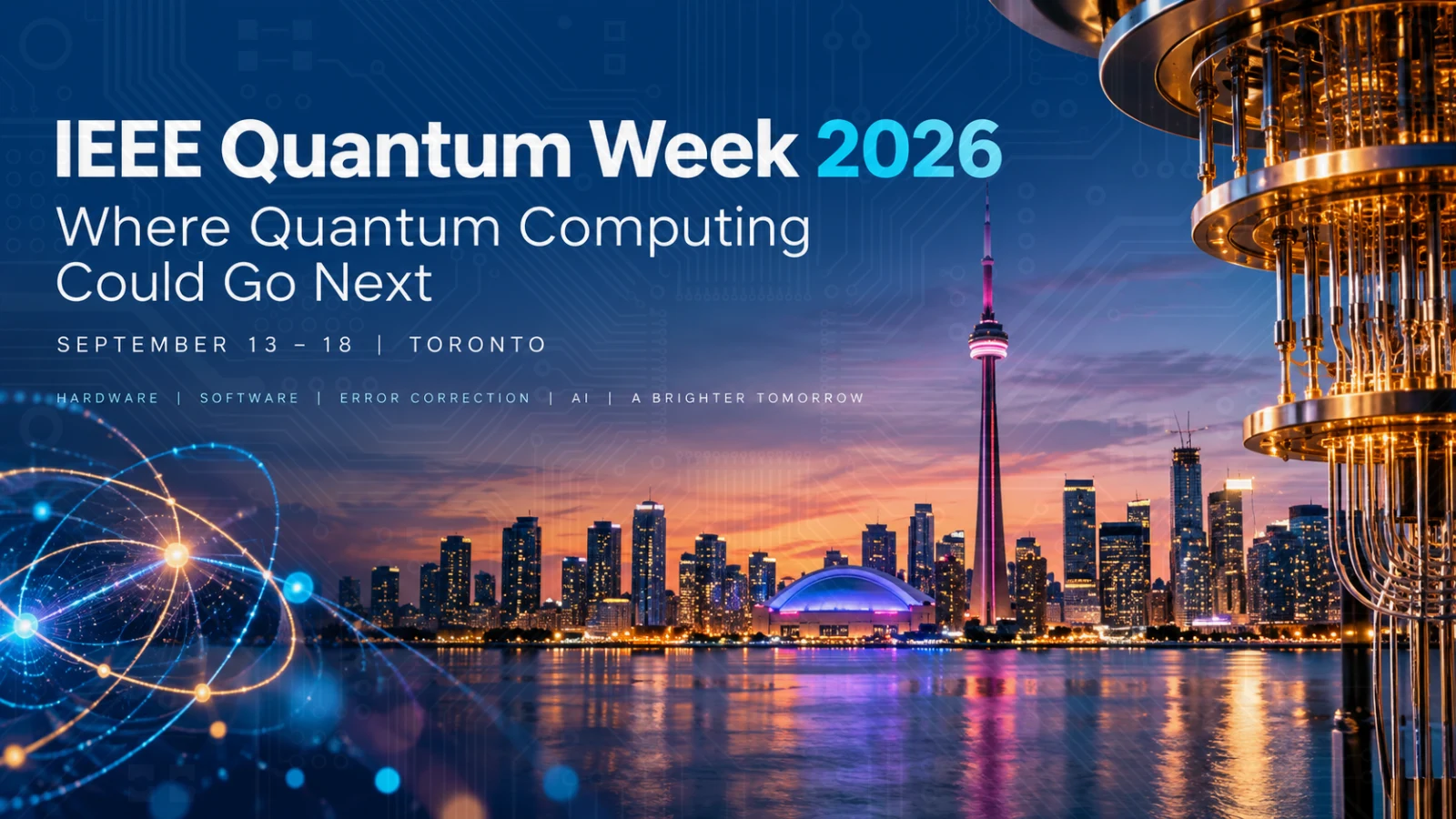
IEEE Quantum Week 2026 will take place from September 13 to September 18 in Toronto, bringing together researchers, quantum companies, developers and technology leaders. This year’s event has the potential to demonstrate how the industry is addressing the more difficult challenge of transforming quantum processors into practical computing systems, rather than solely concentrating on larger qubit counts.
One of the most important subjects could be quantum error correction. Today’s quantum computers remain extremely vulnerable to noise, making it difficult to perform long and complex computations. Discussion of logical qubits, fault tolerance and error-correction architectures could more clearly illustrate how close the industry is to moving beyond experimental machines.
Moreover, the event will be a chance to learn more about the relationship between modern classical infrastructure and quantum computers. Quantum systems in the future are unlikely to operate in isolation. Orchestration, simulation and other workloads could be handled by conventional hardware, along with CPUs, GPUs and quantum processors. This hybrid computing direction is of special interest because of the presence of NVIDIA at the event.
Software could be just as important. Due to the increasing complexity of quantum hardware, developers will need improved programming frameworks, control systems and tools to make quantum hardware work without having to understand all the fundamental physics. The developer layer may be helped to evolve by the ecosystem around IBM’s Qiskit and the broader discussions about quantum software.
Toronto also emphasizes photonic quantum computing. Xanadu CEO Christian Weedbrook is one of the keynote speakers, and the event will have the opportunity to compare photonics to other approaches, including superconducting circuits, trapped ions and neutral atoms. Nevertheless, there is no clear winner in the race to build scalable quantum computers.
Another bright spot is the overlap between generative AI and quantum computing. The IEEE program includes research into the co-design of quantum and generative AI, which prompts the question of whether conventional artificial intelligence can assist researchers in designing circuits, optimizing experiments, controlling hardware, or accelerating discoveries in quantum science.
The biggest story from Toronto may not be one record-breaking announcement. There are hundreds of technical papers on algorithms, hardware, photonics, networking, AI, software, and systems engineering. Instead, IEEE Quantum Week 2026 could show that quantum computers are entering a new era in which the number of qubits in a machine is less important than the quality of the software, error correction and system design.