Google has successfully tested its Gemma 4 AI model on a satellite in orbit, and it returned a poem that was generated by a Tensor Processing Unit (TPU) on board. Google’s Oct. 30, 2026, announcement confirmed Project Suncatcher’s first AI response from space since the satellite was launched Oct. 1.
Prototype was developed in partnership with satellite company Planet and flew on SpaceX’s Transporter-18 mission. Although the spacecraft is an experimental system and not a full-scale data center, its success moves Google one step closer to testing whether AI computing infrastructure could eventually work beyond Earth.
How Google’s Satellite Composed Poetry in Space
Engineers spent several weeks fully checking out the spacecraft’s systems before sending a prompt to the onboard Gemma 4 model. A satellite passing over Svalbard, Norway, transmitted down a haiku that started, “Blue marble below,” and mentioned data streams and starlight.
According to Google’s announcement on October 30th, the response was generated by a data-center-class TPU running in orbit. Engineers also evaluated limericks and prompts that asked about the technical status of the spacecraft.
Poetry was a good way to check the whole process. The satellite received a command from Earth, processed it through an AI model on its own hardware and relayed the response back to Earth through a ground station. Communication did confirm that the basic computing system could function in orbit without the need for a heavy or taxing AI load.
Four AI Chips Still Don’t Have the Power
TechCrunch says the Google prototype has four TPUs and a power supply capable of delivering up to one kilowatt. Operations are limited to one TPU at a time and roughly 20 minutes in duration due to the availability of electricity.
This limitation is important when comparing the spacecraft to conventional data centers. Ground-based facilities have lots of electrical power and cooling equipment, so they can keep large numbers of processors running all the time. Google’s orbital prototype has successfully run an AI response, but it has yet to show it can sustain similar computing workloads.
Today’s testing is more about the behavior of the hardware than the performance in the marketplace. Google has not announced any plans for an orbital AI service, public access to its satellite processors, or independently verified computing benchmarks from the mission.
Why Google Wants to Put AI Data Centers in Space
Project Suncatcher would use solar-powered satellites as the computing infrastructure. Google says solar panels in the right orbital conditions can generate up to eight times the power of equivalent panels on the surface of the Earth, with some low Earth orbits getting sunlight for a large part of the day.
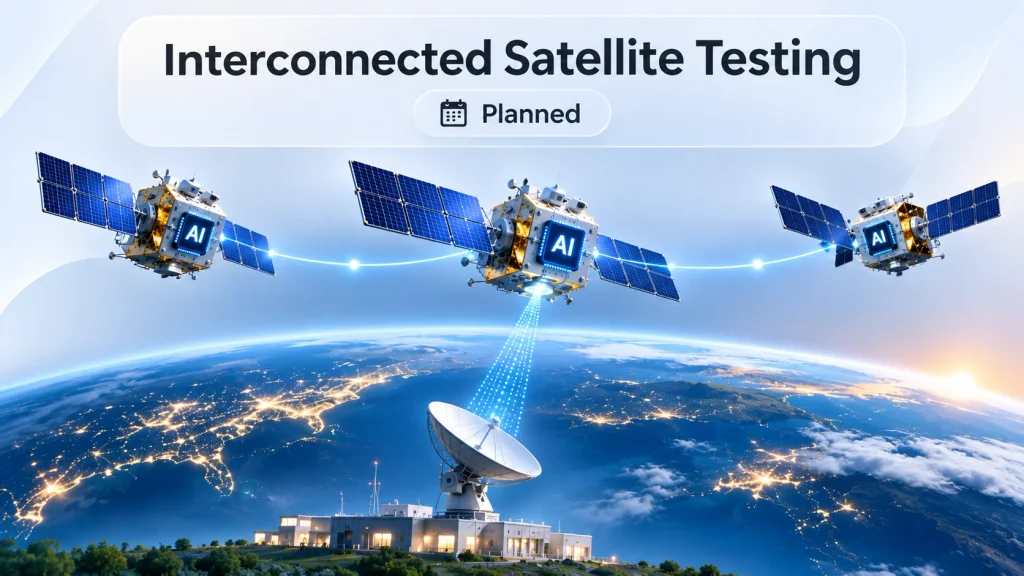
Instead of a single, huge facility in space, Google’s research design is for smaller satellites to work cooperatively through high-speed optical connections. Processors on separate spacecraft could use laser communication to help the exchange of information needed for more complex AI tasks.
Researchers have created a model of a constellation of 81 satellites flying in a tight formation around 650 kilometers above the Earth. In lab experiments, a single transceiver pair has also been used to achieve a combined two-way optical transmission of 1.6 terabits per second.
Neither of these scenarios suggests that such a network is currently in orbit. Current satellite testing is to fill a requirement that had been established much earlier: reliability of the computing hardware in an environment not controlled on Earth.
Radiation and cooling still have to be tried.
In a typical server facility, problems associated with space rarely arise. Radiation can change the information stored in electronic memory, leading to wrong calculations without any obvious hardware failure.
Google’s Trillium TPUs have been previously tested with proton radiation in the lab. Results indicated that further testing is warranted, but the behavior of processors under true orbital conditions over extended periods of time must be evaluated.
Another problem comes from the heat withdrawal. Satellites can’t rely on the surrounding air to cool processors, so waste heat must be conducted to radiators and dissipated into space. The length of time a piece of computing hardware can operate is influenced by temperature variations, solar exposure and the amount of power on board.
Google plans to use its existing spacecraft to explore these conditions. Future data center designs will be focused on consistent and reliable performance over time, not the completion of a short language-model request.
Are space data centers cheaper?
Financial feasibility is still an open question. On November 2, Data Center Dynamics reported that Amanda Peterson Corio, Google’s global head of energy and power, said at The Information’s Women in Tech, Media and Finance Summit that space data centers could be up to 100 times more expensive than terrestrial facilities under current conditions.
Google’s research is exploring an option where the launch cost dips to less than $200 per kilogram by the middle of the 2030s. Those prices could make orbital computing more economically feasible, but they rest on assumptions about the future of spacecraft, manufacturing and rocket launches.
Moreover, any cost comparison must include the replacement of malfunctioning equipment, maintenance of satellite formations and communication with Earth. Solar energy is cheap and readily available, but that doesn’t mean it makes AI processing cheaper.
Expected Workflow: Google Project Suncatcher
-
01
Solar Power Generation
Satellite solar panels collect sunlight and supply electricity to onboard computing hardware.
-
02
AI Request From Earth
Engineers send a prompt from a ground station to the satellite.
-
03
Satellite Receives Data
Communication equipment receives the request and passes it to the onboard computing system.
-
04
TPU Processes AI Model
Google’s onboard TPU runs Gemma 4 to generate a response, such as the demonstrated poem.
-
05
Thermal Management
Satellite hardware must transfer processor-generated heat to radiators that release it into space.
-
06
Response Transmitted to Earth
Satellite communication equipment sends the AI-generated response to a ground station.
-
07
Ground Verification
Engineers receive the response and check the communication and computing results.
What’s next for Project Suncatcher?
Google’s next project is a pair of interlinked satellites for 2027. Instead of a single-spacecraft demo today, the mission is expected to test communication between satellites and provide data on how AI hardware works as part of a distributed system.
Proposed orbital network would be closer to technical feasibility if it had reliable processors, practical cooling arrangements and successful optical connections. Question of long term maintenance and launch costs will be there.
Now, Project Suncatcher has successfully accomplished a fundamental task that future orbital computing systems will have to do: process an AI request in space and send the result back to earth.