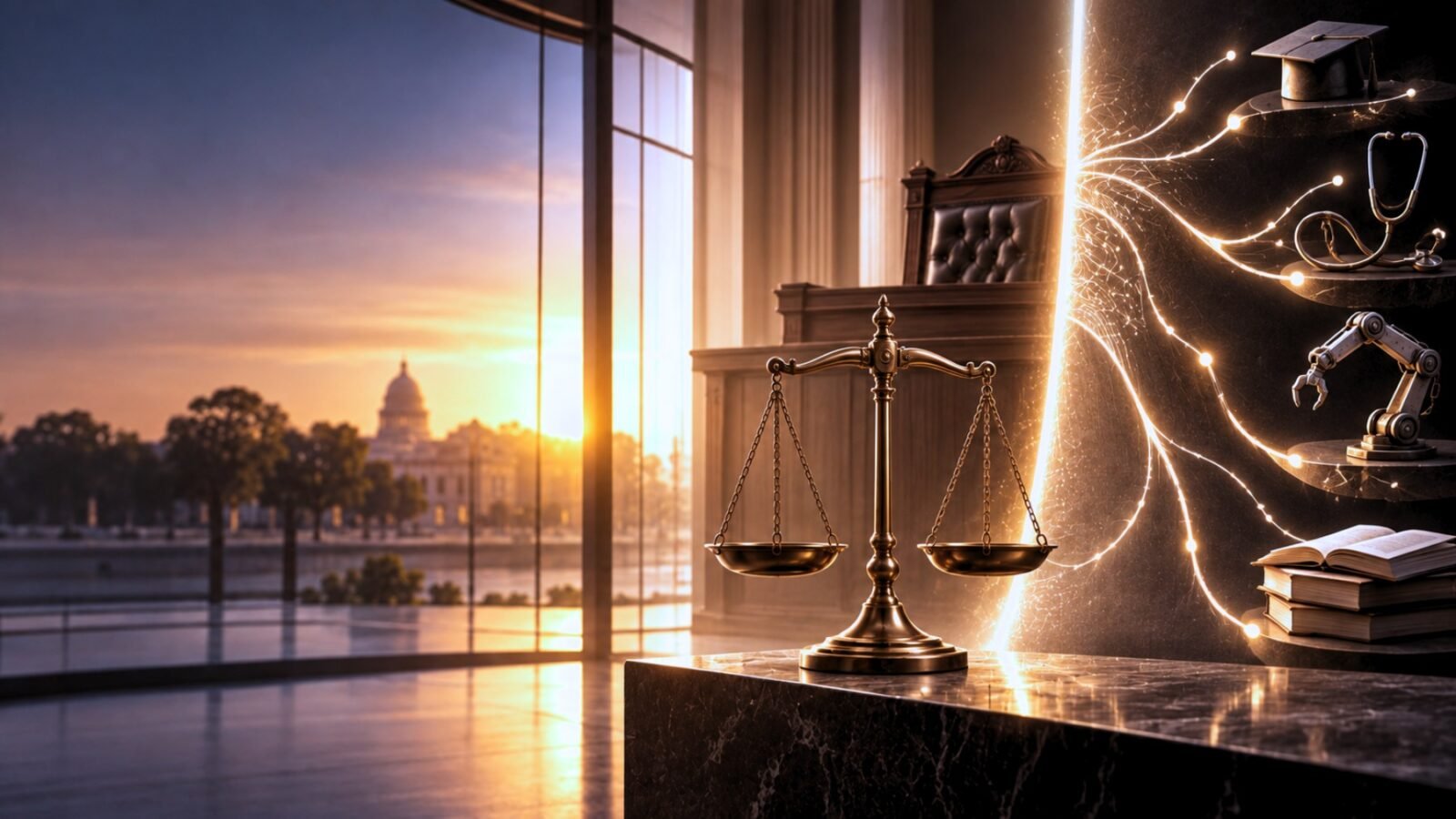
For years, artificial intelligence has been crossing boundaries once thought to be permanent. It writes software, reviews contracts, analyzes medical images, handles customer complaints and, increasingly, controls machines in the real world.
Now Bill Gates wants society to decide if there are lines A.I. shouldn’t cross, even if the technology can cross them.
This protected area he calls “Human Reserved.”
The idea is to treat some forms of work like a nature reserve, with inspiration from conservation. It is not that development is impossible, but development would destroy something valuable. Society is protecting a reserve.
Gates applies the same logic to work. Yes a machine may be able to do a task in time, but society may decide that that task should stay in human hands.
The most important part of his proposal is to distinguish between what artificial intelligence is able to do, and what it should do.
What does “Human Reserved” mean?
Gates, in an essay published Aug. 26, warned that AI could upend intellectual and physical work more quickly than previous technological shifts.
Jobs for people at the entry-level and mid-level are under particular pressure, Gates said. Sales, customer support, software engineering and paralegal work might be among the first to go. More capable robots could eventually compete for some jobs in construction, hospitality and other hands-on industries.
His worry isn’t just that occupations change. Economies based on human labor may soon have to reckon with machines that can scale human cognition and physical work.
One common response is that new technology also creates jobs. History supports that argument. History does not guaranty that new opportunities will appear in the right places, at the right time, or for the same people whose livelihoods disappear.
What good is it to a displaced construction worker in another city if it takes years of education to qualify for a specialized AI role that is created in one city?
Productivity may rise, but individual families and communities may become less secure.
Caregiving reveals what automation cannot replicate
Human Reserved is Gates’ tribute to his father, who died in 2020 after battling Alzheimer’s disease.
By the time of his later illness, professional caregivers learned to read needs that he was not always able to communicate. Gates feels there was something irreplaceably human about the care they gave.
Technology can still play a big role in caregiving.
AI could monitor medications, detect falls, understand speech, sort through medical records and tell a busy nurse when a patient is going downhill. Each use could improve care and relieve the pressure on medical professionals.
However, assistance is not the same as relationship. Predicting is not caring.
A machine could produce medically correct language for telling someone that a disease is incurable. It bears no moral responsibility for how that truth comes into the life of the person.
The professional who delivers such news is doing more than delivering information. They read silences, recognize fear, explain uncertainty and remain present once the message has been delivered.
What AI decisions should humans make?
Outside medicine, similar principles are at play.
A judge’s sentencing, a social worker’s decision to take a child away from home, a military officer’s authorization of lethal force, and a teacher’s response to a student in distress are all legitimate only so far as they are the product of accountable human judgment.
Alternatively, AI may not always make less accurate predictions. Accuracy is not sufficient for legitimacy or accountability, however.
Society needs someone who can be questioned, challenged, persuaded and held to account.
A more practical version of Gates’s proposal would protect consequential decisions and encounters, rather than trying to reserve entire occupations.
Protect decisions, not titles
Most jobs have a mix of routine, analytical, interpersonal, and morally consequential tasks.
A doctor reads records, notices patterns, suggests treatment, explains options and comforts families.
A teacher plans lessons, corrects work, observes changes in behavior and helps students to gain confidence.
Lawyers review documents, draft language, advise clients and represent clients in court.
Some of those tasks are a good fit for automation. Others carry a social, legal or moral weight that cannot be collapsed to efficiency.
Under a Human Reserved model, decision-based:
AI could be able to suggest a medical treatment but the decision and the explanation would still be up to a qualified clinician.
Software might flag suspected fraud, but it could not independently terminate a family’s benefits.
An algorithm could help rank job candidates, but significant rejections would be reviewed by people and would have an appeal path.
AI could evaluate evidence but could not independently determine a prison sentence.
A military system might be able to detect potential threats, but then a human would be in the loop for decisions involving lethal force.
This would allow AI to cut down on paperwork, improve analysis, and increase access while maintaining human control where rights, dignity, safety or irreversible harm is a concern.
Ceremonies without human reviewers
Asking someone to click on a “Approve” button wouldn’t solve the problem.
The organizations may say there is a human in the loop, but not give that worker enough time, information or authority to challenge the system.
A Human Reserved policy with any bite would need to include at least four safeguards:
The named human decision-maker who has the authority to reject an AI system’s recommendation.
A clear description of the way the decision was affected by AI
An honest appeals process for everyone affected by the result.
Legal liability that cannot be shifted to an algorithm or technology vendor.
Without those protections, “human in the loop” is a compliance label, not a real protection.”
Human reviewers need to be able to intervene, not just rubber-stamp what a machine has already decided.
Who decides what is still human?
Gates acknowledges that many tough questions remain to be answered.
Different countries are not likely to use the same boundaries. A country with a dire lack of elder-care workers might be more willing to turn to robotic help than one with a larger pool of available workers.
Culture will also influence those choices, including how people view doctors, teachers, public officials and family care.
Businesses cannot be left to draw the line on their own. It’s natural for companies to want to automate when machines are cheaper, faster and always on.
Tech companies can provide the technical expertise, but decisions about rights, dignity and social risk require wider public participation. Workers, patients, caregivers, educators, labor experts, communities, and elected governments all have a legitimate role to play.
It would also need regular boundary review.
A job that is too dangerous to automate today might be safer to automate tomorrow as systems get better. Society may also discover that an apparently harmless substitution damages professional skills, public confidence or human connection in ways that were not evident at the time of the technology launch.
So Human Reserved should be seen as a living boundary not a list that is set once and for all by a government.
Gates also wants taxes on robots and AI
But protecting some decisions won’t stop all job losses.
Gates pairs Human Reserved with another controversial idea: taxing AI use and robots.
Current tax systems can encourage replacing workers, he says, because employers pay payroll taxes when they hire people, while machines may be treated as deductible business expenses.
The proceeds of an AI or robot tax could be used to pay for retraining of workers and to bolster the social safety net.
A tax like that would be hard to implement. Governments would need to determine what constitutes a robot, to differentiate between assistance and labor substitution, and prevent companies from moving taxable activity across borders.
Gates also says any tax should be carefully targeted to avoid hampering beneficial social uses of AI, such as applications that increase access to health care or education.
The tax mechanism proposed is more difficult to understand than a broader principle: that part of the economic gains created by automation should help finance the disruption automation causes.
If productivity increases dramatically, but the displaced workers pay the bulk of the price, the transition may resemble efficiency on a spreadsheet but be neither socially nor politically sustainable.
The real frontier is human responsibility
Human Reserved is unlikely to be a simple list of occupations labeled “people only.” A strict ban could deprive patients, students and communities already struggling with a shortage of qualified professionals of useful technology.
It is more valuable as a test for any organization that is deploying AI:
If this system gets it wrong, who is responsible to the person who is harmed?
The honest answer is “no one.” Automation has gone too far.
AI will continue to develop skills that seemed possible only for humans. Society does not have to demonstrate that humans are better than machines at all tasks.
Instead, people have to decide where human presence, judgment and accountability still matter, even when a machine seems faster, cheaper or statistically more accurate.