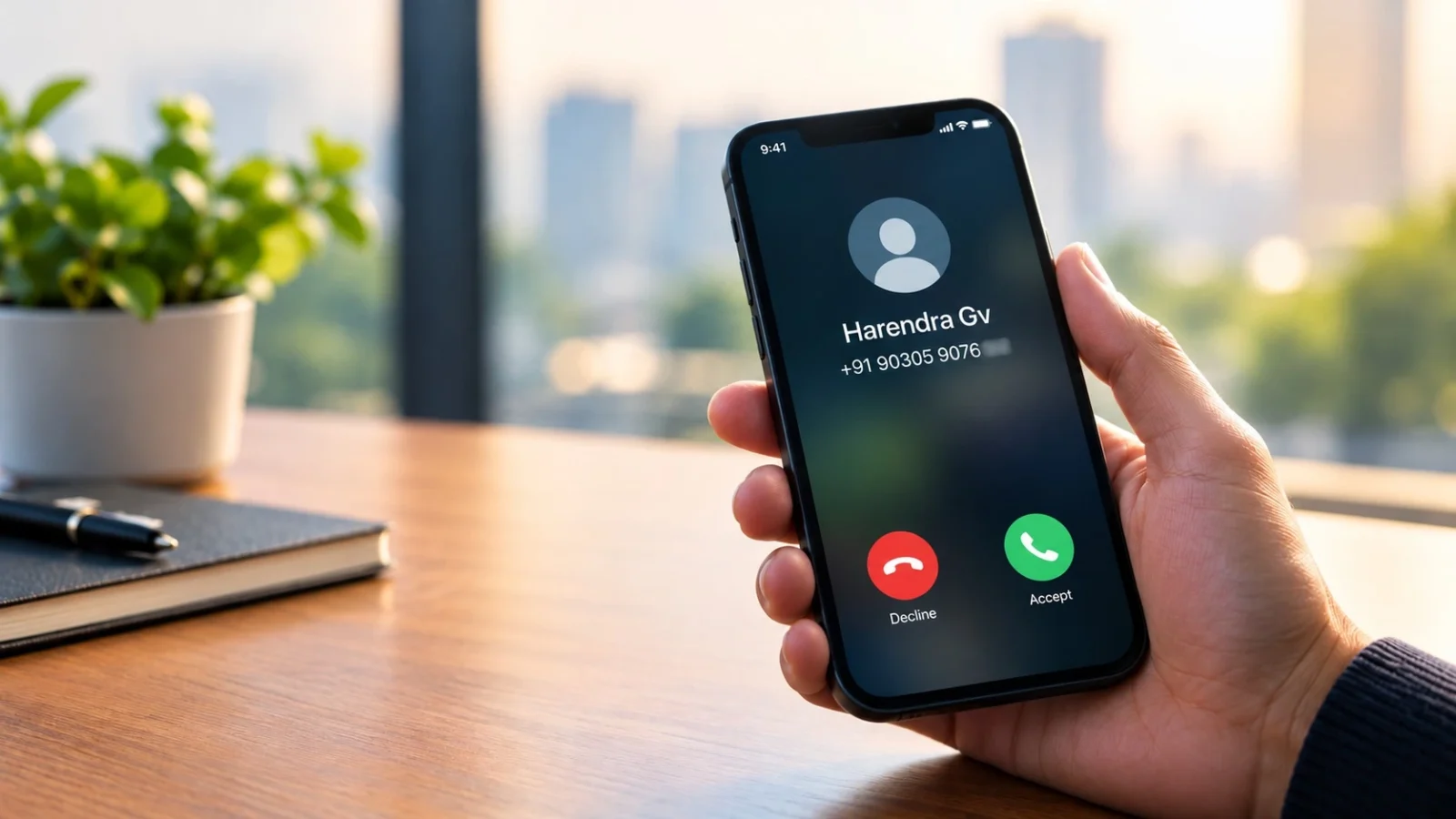
India’s Department of Telecommunications has directed all telecom operators in the country to enable a service called Calling Name Presentation or CNAP by November 1, 2026, an order dated October 13, 2026, said. Since then, an incoming call to an Indian mobile number is supposed to display the name of the caller on the screen along with the number. No app download, no separate request and no charge mentioned in the circular.
The directive has been sent to all access service providers including Reliance Jio, Bharti Airtel, Vodafone Idea and state-run BSNL and it is applicable in all service areas. The first phase is for wireless networks using 4G and above technologies where operators have already been running trials. 2G, 3G and fixed-line networks are deferred to a separate decision later.
What you will see on the screen.
When a call comes in, the phone will show two fields: the number of the caller, as it does today, and a second field with the caller’s name. If the recipient’s contacts already contain the number, the name stored there takes precedence. For unlisted home numbers, the display shows the name stored in the subscriber database of the caller’s operator, and the name collected during the KYC process when the SIM was issued.
International calls, priced differently. If the recipient does not have the number in his or her contacts, the screen will display “International Call” rather than a name.
Businesses have a way to document their brand on the subscriber record, rather than the name. The operator may offer a “preferred name” instead of the name in the operator’s records to a holder of a business or bulk connection, but the operator has sole discretion to offer it. Where available, the preferred name shall be a trade name registered on the GST portal or a trademark registered with the Trade Marks Registry. The operator needs to check the documents before accepting the request. Existing subscribers can apply to change the name displayed.
Where is the name from
According to the circular, each originating operator will maintain a database mapping subscriber names with phone numbers. When a call comes in, the terminating operator, the network of the person receiving the call, checks that database and puts the name on the screen of the person receiving the call.
The name wasn’t crowd-sourced. This is from the Customer Application Form filled during subscriber verification. This is the point that TRAI pressed in its 2024 recommendations: third party caller ID apps depend on crowdsourced databases, which can be wrong, while the operator’s record is linked to a verified identity. The circular adds a security-by-design requirement: the query must be constructed in such a way that the calling name is not retained after the call is over. Operators also must set up a time-bound grievance process for complaints about wrong or missing names.
The technical basis is in line with the international standards for the supplementary service: ITU-T I.251.9 and ETSI TS 122 096.
4 years from proposal to mandatory.
This mandate is the result of a long regulatory thread. The DOT India had asked TRAI to explore the possibility of introducing caller name presentation on Indian networks in March 2022. TRAI recommended on February 23, 2024, that the service be provided by all access providers on request after consultations, saying it would help recipients identify callers from verified records.
This was followed by operator trials on 4G and 5G networks. On September 26, 2025, the department sent the proposal back to TRAI asking that the service be switched on by default, and not request only. TRAI agreed to default activation on 28 October 2025.
The 13 October circular makes the default part final. It refers to Rule 48 of the Telecommunications (Authorisation for Provision of Principal Telecommunication Services) Rules, 2026, which mandates that caller identification should be displayed in a manner secured against tampering, and to the Unified Licence condition that requires operators to provide caller identification. An associated amendment to the Unified Licence redefines calling line identification to include the name recorded in the subscriber data record, in addition to the number.
A point that needs careful attention is the lack of an opt-out procedure in the final circular. If you have the calling line identification restriction facility (CLIR) then your name will not be displayed. But in India since 2015, CLIR has been restricted to government officials and VIPs, while others have to obtain a recommendation from senior police officers to obtain it. For most subscribers the name will simply appear, with no indication of a way to turn it off. The circular also does not say how the service will work while roaming, whether virtual network operators are included, what handsets are needed and what penalties an operator will face if it misses the date.
How this compares to the United States
India has a different approach to caller identification than the United States. The US system, STIR/SHAKEN, uses digital certificates to verify that the number being called was authorized by the originating carrier. It grades the authenticity of the number. Not the name. Branded calling, which shows a business name and logo on the recipient’s screen, is available in the US, but only as a commercial service that businesses pay for and customers accept.
The gap has not gone unnoticed by the Federal Communications Commission. The FCC voted unanimously on October 28, 2025, to consider rules that would require terminating providers to display verified caller name information when a call has the highest level of STIR/SHAKEN attestation, and to mark calls that originate outside the country. That proposal is still open for comment. It is not an order.
India is taking the lead with a government order, not a market offering. India is one of the two largest mobile markets in the world, and CNAP will be switched on for hundreds of millions of subscribers at once, never before tried at this scale by any other country. If the service performs as advertised, it would be the largest of its kind anywhere.
The policy is simply explained by the numbers. Americans received about 4.2 billion robocalls in April 2026, or about 13 per person, according to the Congressional Research Service. The FTC also received more than 2.6 million Do Not Call complaints in fiscal year 2025. India has its own share of spam and fraud calls, and the government’s solution includes CNAP. The outcome to watch is the effect of default name display in both countries on reduction of fraud.
What happens to caller ID apps?
Truecaller built its business on the gap that CNAP now fills. In response to TRAI’s 2024 recommendations, the company said it does not consider CNAP as a service that can be compared with the entire set of services and functionalities it provides. It referred to the 374 million plus users at that time. The app’s database is crowdsourced, so names come from users’ contacts, meaning the identity attached to a number can be anything typed in by somebody.
Instead, CNAP responds with the operator record. For the normal case of an unknown number with no context, the verified name in the screen does most of what a caller ID app does, without installation. The apps still have benefits that CNAP doesn’t address: spam scoring, automatic call screening and databases that cover numbers outside of India’s operator records. The mandate does not prohibit third party apps. This makes the built-in answer good enough for everyday use.
What is left unanswered
The circular leaves a practical open question. The service is provided free of charge. It does not set out the process for correcting a wrong name, except to require operators to run a complaint mechanism. The department’s own tests identified technical hurdles, including antiquated software on some networks, before the system works, and operators must figure out the database queries, cross-network coordination and handset compatibility before Nov. 1.
2G/3G not included. A large part of India’s subscriber base is still on older networks or feature phones and such users won’t see names till the department looks into the matter separately. Landlines are no better off.
The order is simple, as it stands: the unknown number is to come with a name, beginning November 1. By government order, India will be the first country to try verified, network-level caller name display at this scale. The results will give regulators everyplace, including Washington, real data on whether knowing the caller’s name makes people answer their phones differently.