
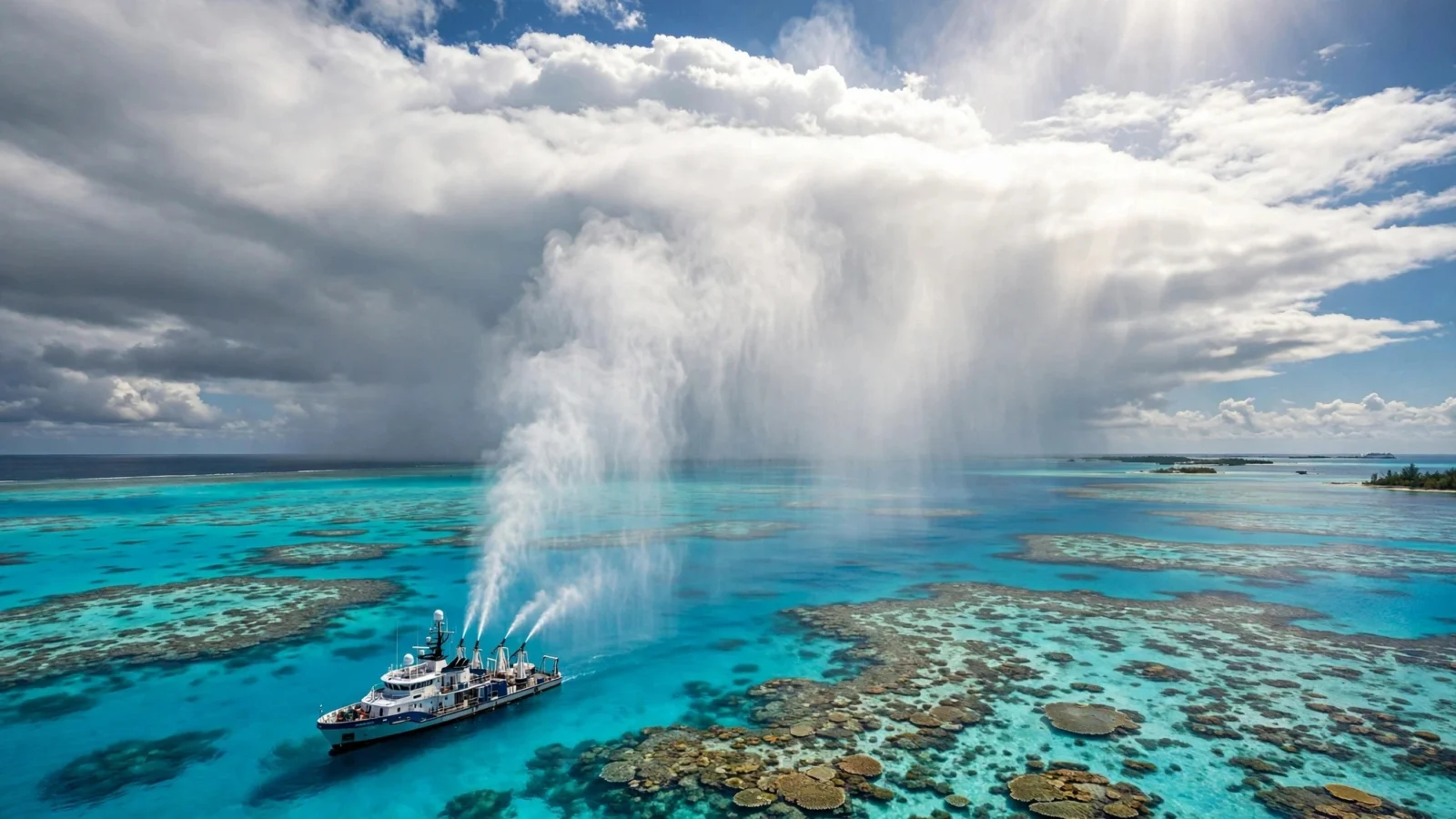
Marine Cloud Brightening
Marine cloud brightening is a proposal to cool a patch of ocean, or in larger designs the planet, by spraying tiny particles of sea salt into low clouds over the sea. The salt offers more particles for water vapor to condense around. Thus, a cloud containing the same amount of water, but in the form of more, smaller, droplets will reflect more sunlight than a cloud with fewer, larger, droplets. No clouds are made out of nothing, and no chemical is added that the ocean does not already put into the air. The spray is attempting to run a process that waves and ship exhaust have been running over the oceans for decades, but in a selected place, at a selected time, on purpose.
The concept has gone from paper to hardware. A team at Southern Cross University in Australia has completed six outdoor field seasons over the Great Barrier Reef since March 2020, and in 2025 the team published the first measurement showing that salt sprayed from a vessel at the surface reached cloud base height in higher numbers. In April 2024, a University of Washington team tested a spray machine on the deck of the USS Hornet in Alameda, California. Two months later, the Alameda City Council voted unanimously to end the experiment. In May 2025, the UK’s Advanced Research and Invention Agency, or ARIA, awarded £56.8 million to an Exploring Climate Cooling program that includes two seawater spray projects among its 22 awards. All these programs are not cooling the climate today. Each is trying to answer a narrower question: can a machine make the right particles, can those particles get to a cloud and does the cloud answer in the way the equations say it should?
MCB – what it is and what it is not
Marine cloud brightening is a member of a family of proposals called solar radiation management. The idea is to bounce some of the incoming sunlight back out into space before it reaches the surface and heats it up. This is different from carbon removal. Brightening a cloud does nothing for the carbon dioxide already in the air. And it does nothing for ocean acidification, which carbon dioxide drives on its own track. Every research group working on the method, from Southern Cross University to the University of Washington, says the same limit in its own program material: brightening is studied as a way to cut heat stress for a period, not as a substitute for cutting emissions.
It is also not the same as weather control in the rainmaking sense. Rainmaking (or cloud seeding), performed in several western states of the United States, tries to get water out of some cloud that happens to be there on a given day. In one sense, marine cloud brightening does the opposite. Smaller droplets do not rain as easily, so a brighter cloud can hold its water longer and cover more sky before it rains out. “It’s not a storm on a date, it’s the brightness of the cloud deck over days and weeks.”
The physics: more seeds, smaller droplets, a brighter cloud
A cloud droplet cannot form in clean air by itself. Water vapor needs something to condense on, and those things are called cloud condensation nuclei. Air over land contains from 1,000 to 5,000 such particles per cubic centimeter from dust, pollen, smoke and exhaust. Over the open ocean the count falls below 100 per cubic cm, and may fall to 10. MCB method runs on the opening that clean ocean air is in need of seeds.
This method uses a relation published in 1977 by cloud physicist Sean Twomey. The more nuclei that are added to a given amount of liquid water in a cloud, the more droplets there will be and the smaller they will be. Smaller droplets have more total surface area to incoming sunlight, so the cloud reflects a larger share of it. The effect is known in the literature as the Twomey effect. A second effect, described in 1989 by Bruce Albrecht, has to do with what happens next. Smaller droplets collide and coalesce less, rain develops more slowly and the cloud can persist longer and spread further. A longer-lived cloud reflects sunlight for a longer number of hours.
Brightening machine operation consists of four steps. A pump sucks in seawater and a spray of nozzles atomizes it into a fine mist. In the marine air, water in each mist droplet evaporates leaving a dry salt particle. Turbulence in the lowest layer of the atmosphere, the marine boundary layer, stirs those particles up over about an hour. As air rises at the cloud base, it transports the particles into the cloud, water condenses on them, and the droplet count inside the cloud increases. It is not an exotic salt. Every day the same material is put into the same air by sea spray from breaking waves. The machine differs from a wave in output and in purpose. It must make particles of a given size in very large numbers under a cloud that can make use of them.
Ships have already accidentally run the experiment
The best evidence for extra particles brightening ocean clouds did not come from a brightening machine. It came from the freighters. A ship’s funnel emits exhaust into the air which seeds a line of cloud along its path. Satellites see these lines as ship tracks, bright lines within a duller cloud deck. James Conover saw the lines in early satellite images in the 1960s and related them to ship emissions. Ship tracks are the visible evidence that a single moving source can change the droplet count of a cloud by its particle plume for tens of miles.
As of January 1, 2020, the International Maritime Organization lowered the allowable sulfur content of marine fuel from 3.5 percent to 0.5 percent. Sulfur in exhaust was a big source of particles that seeded ship tracks. NASA scientist Tianle Yuan and coauthors tracked the result in satellite records and found that ship track density dropped in every major shipping lane in 2020 and remained at record low levels into 2021, with the fuel rule – and not the pandemic drop in traffic – as the primary cause. Yuan and colleagues, in a 2024 study in Communications Earth and Environment, treated the rule change as a reverse termination shock: an accidental brightening program run by the world’s shipping fleet had been switched off at once, and they calculated the extra warming that followed from dimmer clouds. The magnitude of such warming remains a matter of debate in the literature. But not the direction of the change. Fewer particles meant dimmer clouds, and dimmer clouds meant more sunlight reaching the sea.
Shipping record answers one question and leaves the hard one open for brightening research. Particles from a moving source clearly enter clouds and clearly change them. But a ship’s exhaust is a dirty and uncontrolled source. It says little about whether a clean salt spray, built to a set particle size and aimed at a selected cloud deck, produces a measured cooling that a research team can repeat.
The spray is the tricky part in Marine cloud brightening
Size of the particles determines whether brightening will work or backfire. Too big a particle seeds a droplet which grows fast, collects its neighbors and falls out as rain, thinning the cloud. A small proportion of oversized particles in a spray can ruin the effect of the rest. If the particle is too small it may never activate into a droplet.
The University of Washington Marine Cloud Brightening Research Program publishes its design targets as mere numbers. Mmachine to generate marine stratocumulus clouds should generate 10¹⁵ to 10¹⁶ sea salt particles per second with dry diameters from 10 to 200 nanometers, with a peak near 30 to 60 nanometers. Less than 1 to 2 percent of the particles are wider than 2,000 nanometers. Plume must also mix upward through the boundary layer and reach cloud base spread out, not as a narrow jet. Salter’s original vessel design in 2008 used a different approach toward the same goal: seawater droplets of 0.8 microns, sprayed at 30 liters per second from wind driven rotor ships, for about 10¹⁷ nuclei per second per vessel. The numbers differ by group and decade. Engineering problem is identical in each version. No industry has ever had to produce trillions of near identical particles of salt every second, at sea, in salt air that eats metal and clogs fine nozzles.
Australia’s machine, in action, shows what the work is like. The first generation sprayer tested in 2020 used an effervescent nozzle assembly with 100 nozzles in 10 radial manifolds fed by filtered seawater. It generated an estimated 2.7 × 10¹⁴ sea salt particles/sec with a mode near 40 nm from 20 mL of seawater/sec. Southern Cross University says its current system has 640 nozzles, each releasing about a thousand trillion droplets per second. Between those two figures is six years of nozzle redesign, the bulk of the effort of the Australian program.
Great Barrier Reef trials: a local, not a global job
This program in Australia is not about cooling the planet. It’s trying to cool the water over parts of the Great Barrier Reef during the summer heat weeks that bleach coral. When the seas stay hot, coral turns white and spits out the algae that feed them. Southern Cross University has recorded six major bleaching events on the Reef in the past decade and its program material says oceans absorb about 90 percent of the excess heat trapped by greenhouse gasses. A brighter cloud deck over a reef flat reduces the light and heat reaching the water during a marine heatwave, which is the stress window for bleaching.
The first outdoor trial was run off the Queensland coast in March 2020 as part of the Reef Restoration and Adaptation Program, a research effort funded through the partnership between the Australian Government’s Reef Trust and the Great Barrier Reef Foundation. The shipboard sprayer, inspired by a snow cannon, atomized seawater at a rate the team calculated in hundreds of trillions of droplets a second. The 2021 season was about following the plume, mapping the salt movement in the boundary layer with aircraft and surface instruments. In later seasons, a dedicated airborne research facility was added to sample the cumulus clouds over the Reef and record how their droplet properties changed with the aerosol present in the air below.
The program didn’t get past proof of machinery until 2025. Hernandez-Jaramillo et al. (2025) reported in Environmental Research Letters that airborne measurements from the first generation trial revealed higher aerosol concentrations downwind of the sprayer at cloud base height. Simply put, salt from the surface of the sea was getting up to where clouds form, in numbers a sensor could count. The finding is narrow and the authors do not exaggerate it. Nor does it prove that a cloud got whiter, that water over coral cooled, or that bleaching dropped. It closes the first link in a four-part chain; make the particles, deliver them to cloud base, change the droplets, cool the surface. The second, third and fourth links are the subject of the bigger multi vessel trials the university now says is its next step, along with three permanent monitoring stations along the Reef and finer spray technology that uses less energy.
Throughout the design of the Australian program, consent is a running theme. Southern Cross University has a self-imposed rule that it will not conduct research on Sea Country without the free, prior and express consent of Traditional Owners. The program works with Traditional Owners, regulators and regional stakeholders as named partners. That practice is of record in the method because the other big outdoor test of brightening hardware died on the question of who agreed to what.
Alameda: the ground-aborted, not air-aborted, test
The University of Washington team started outdoor tests of its Cloud-Aerosol Research Instrument, CARI, on the flight deck of the USS Hornet, a retired aircraft carrier that is now a museum in Alameda, California, April 2, 2024. It was a study from the program’s Coastal Atmospheric Aerosol Research and Engagement facility, or CAARE. The program’s own description says the work in Alameda was a study of the spray and the air around it, not a cloud experiment. Releases were scheduled to take place for 5 to 10 minutes at a time, a maximum of 30 minutes, a few times a day on a few days a week, and instruments measured the salt particles downwind up to 200 meters. The declared goal was to understand the dispersion of a point source plume in the turbulent lower atmosphere, data which is input into models of ship emissions and smokestacks and also into brightening models. The program says the Alameda studies were not intended to influence local weather or climate. The work would be logged with NOAA’s weather modification reporting process.
The city halted the test in May 2024, saying it violated terms of the Hornet’s lease. Alameda then funded an evaluation of its own. It appeared to be naturally occurring sea spray and did not pose a measurable health risk to the surrounding community or wildlife, the consultants who authored it told the City Council on June 4, 2024. But that night, the council voted unanimously to end the experiment anyway, citing health and environmental concerns raised by residents, many of whom learned the full scope of the test from news coverage after it began. In early details, the researchers had been tight-lipped, a choice the program has since addressed with the CAARE design, which includes public engagement, access for regulators and work with Indigenous Peoples and Global South communities in the stated purposes of the facility.
Read together, the Reef and Alameda records draw a line within which the whole field now works. Even a spray test that is technically sound can fail if those downwind hear about it too late. In this study, consent and notice are not mere decoration. Before the particle data, they were the deciding factor in Alameda.
What full-scale brightening might do, according to computer models
No outdoor test has ever brightened a cloud deck at climate scale, so every statement about planet level cooling is a model statement. Those statements are to be interpreted as model output (with the model identified), not as forecasts.
In 2025, Chen and colleagues ran the Community Earth System Model, CESM2, and published a study in the Journal of Geophysical Research: Atmospheres. The team seeded the ocean areas that the model ranked as most amenable to brightening under the SSP2-4.5 emissions pathway. In that model, seeding 5 percent of the ocean surface would yield 1 degree Celsius of global cooling. The same run produced two costs in the output. The cooling pattern resembled La Niña, with the tropical Pacific cooling in a way that redistributes rain globally. Overall global precipitation decreased, increasing over land and decreasing over the ocean. A subsequent regional study in Environmental Research Letters, also using CESM, kept global temperatures near 1.5 degrees Celsius above preindustrial levels with seeding over 5 percent of the global area from 2031, reduced drought stress over 55 percent of land by midcentury, and increased plant growth on land by 3 to 4 percent by 2100, through changes in light and water.
Cloud physics is the reason for the large spread between models. In 2024, Feingold and co-authors, a group of 31 scientists writing in Science Advances, made the point directly: observations and models agree that more aerosol can raise droplet counts and brighten a cloud, but the response of cloud amount is unsettled. Extra particles dampen rain and increase cloud cover, which adds brightening. Extra particles may also foster evaporation and mixing with dry air above the cloud, decreasing cloud cover and perhaps darkening the scene. Which answer wins depends on the cloud, the hour, the season and the background air. The authors characterize the competition among those answers as the biggest unknown in determining if brightening can work, and propose a research program of field work, lab work and modeling designed to resolve it.
The failure modes that researchers call themselves
The first failure mode on the list is the overbrightening of the field itself. If you push droplet counts too high in the wrong cloud, the adjustments above run in reverse: the cloud thins, its water content drops and it reflects less sunlight than it did before the spray. The particle size errors go in the same direction. So the group behind the Science Advances paper, convened by NOAA, proposed a series of checkpoints for brightening research, with exit ramps attached. If the program cannot prove that it can make the right particle size, deliver it to cloud base, and avoid cloud responses that cancel the brightening, then the checkpoint design sends the work toward redirection or termination rather than toward a bigger trial.
The second is change in rainfall. La Niña-shaped cooling doesn’t distribute evenly. Rain shifts between ocean and land, and rain shifts between regions, are seen in CESM2 runs, and the checkpoint paper identifies the Amazon as a region where a rain shift would have a heavy cost. A regional use as proposed for the Reef reduces that risk through a smaller area and a shorter season. It does not answer the question of who pays for a change in rain downwind of a brightened deck.
The third is termination, because of the short life of the particles. Within days, sea salt sprayed into the boundary layer is washed out. The spraying lasts as long as the cooling lasts. The 2024 shipping study shows the arithmetic from the other side: take away a source of particles and the clouds dim in the same season. A large brightening program, if stopped suddenly (say, because of war, a loss of funding or a political decision), with greenhouse gasses still high, would reveal its warming at a rate about four times that of the surrounding years, according to the Environmental Research Letters termination run, with land warming past 1 degree Celsius per decade in many regions in the first decade after a stop. That result is an argument made by the modelers themselves against any large use that is not combined with falling emissions. Brightening bought as a delay and then dropped is worse than no brightening.
The fourth limit is ocean acidification, and it’s not a risk, it’s a certainty. Brightening is sunlight reflection. But it does not remove carbon dioxide, so the chemistry that acidifies seawater continues at the rate determined by emissions. Brighter clouds help keep the reef cooler, but the waters surrounding it are becoming more acidic. Australian program leaders say that limit plainly in their own material, calling brightening “buying time for emissions cuts,” which in their modeling is measured as a chance to hold coral cover while those cuts happen.
Who decides: the rules that are and those that are not
There is no treaty for marine cloud brightening. No international body licenses a trial or sets a particle standard or adjudicates a claim of harm across a border. What there is is a mix of domestic law and stated positions.
In their 2021 report Reflecting Sunlight, the National Academies of Sciences, Engineering, and Medicine recommended that the US set up a solar geoengineering research program with research governance built in from the outset, conducted in coordination with other nations, and done alongside emissions reductions, not as a substitute. The current reporting of weather modification to NOAA includes outdoor aerosol work and is a reporting duty and not an approval regime. The Alameda vote demonstrated where effective authority lay in that case: with a city council acting on a museum’s lease.
The clearest government position has come from the United Kingdom. The United Kingdom government says it does not support the deployment of solar radiation modification and has no plans to deploy it, that it supports research that complies with domestic and international rules and that there is no substitute for decarbonization. Its ARIA program is reiterating the boundary from the funding angle. The Exploring Climate Cooling program is not a path to deployment, says ARIA. Finding a method does not work is a valid outcome. ARIA’s five outdoor trials, two of them seawater spray projects, have to pass independent environmental impact and legal assessments that are published before any outdoor work begins. Toxic material shall not be released and trial effects shall be transient for 24 hours or fully reversible. A companion program funded by the Natural Environment Research Council at £10.5 million from 2025 to 2030 works on risks using only modeling and past data and runs a public dialog on the topic. The oversight committee for the ARIA program is chaired by Piers Forster from the University of Leeds, who is also a lead author for the Intergovernmental Panel on Climate Change.
You can see the gap in this patchwork. A trial in a country’s waters, under its own rules, can alter the air and rain across a border. There is no agreed process for a neighbor to object, be compensated, or even be notified as of right. The ARIA conditions and the checkpoint proposal are voluntary structures designed by funders and researchers to substitute rules that governments have not written. It is untested whether they hold at larger scales.
Next to Watch | MCB
Three dated items will show whether this MCB method is advancing or stalling. ARIA’s seawater spray projects have to publish their environmental impact assessments before they begin any outdoor work and those documents will detail particle sizes, release rates and sites where the U.K. is ready to experiment in public. Southern Cross University’s planned multi vessel Reef trials will be the first attempt to go beyond the delivery result of 2025 and measure the second link in the chain, a change in the clouds themselves, with aircraft sampling a sprayed cloud field and a control field in the same weather. The next outdoor study site for the University of Washington program in the United States will be a test of whether the CAARE engagement model built after Alameda can carry a spray study through a public process without a council vote ending it.
Live now on a 4th watch item. In its October 8, 2026 diagnostic discussion, NOAA’s Climate Prediction Center issued an El Niño Advisory, citing the Niño-3.4 index at 2.1 degrees Celsius above average and an 83 percent chance of a strong to very strong event continuing through January to March 2027. The World Meteorological Organization said in an Oct. 8 bulletin that there was a near 100 percent chance the event would last through February 2027 and it predicted a sea surface temperature anomaly of about 3.7 degrees Celsius from October to December in the central and eastern tropical Pacific, past the previous record of 2.6 degrees. The event is expected to peak in December 2026, at the beginning of the summer heat season for the Great Barrier Reef, and persist through February 2027. Scientists at the International Coral Reef Symposium in Auckland in July 2026 rated severe, broad-scale bleaching across the Reef as very likely. This El Niño is also the first to come after a study designed to answer the question itself. In July 2026, Wan and colleagues published in Science Advances that in a seasonal forecast model, cloud brightening over the southeast Pacific weakened a subsequent super El Niño, with the greatest effect when the spraying was started months before the peak. The same work sets the scale of what that would take: some 2,400 spray ships, a fleet that does not exist, built around nozzles that cannot yet spray at the needed volume. “You can basically stop the dominoes from falling early when you do marine cloud brightening,” Wan told New Scientist. “We’re kicking the cycle in the other direction.” This season’s watch-item is not a deployment. The question is whether the record strength of the 2026 event transitions from brightening on journal pages to funded test planning before the next El Niño develops.