
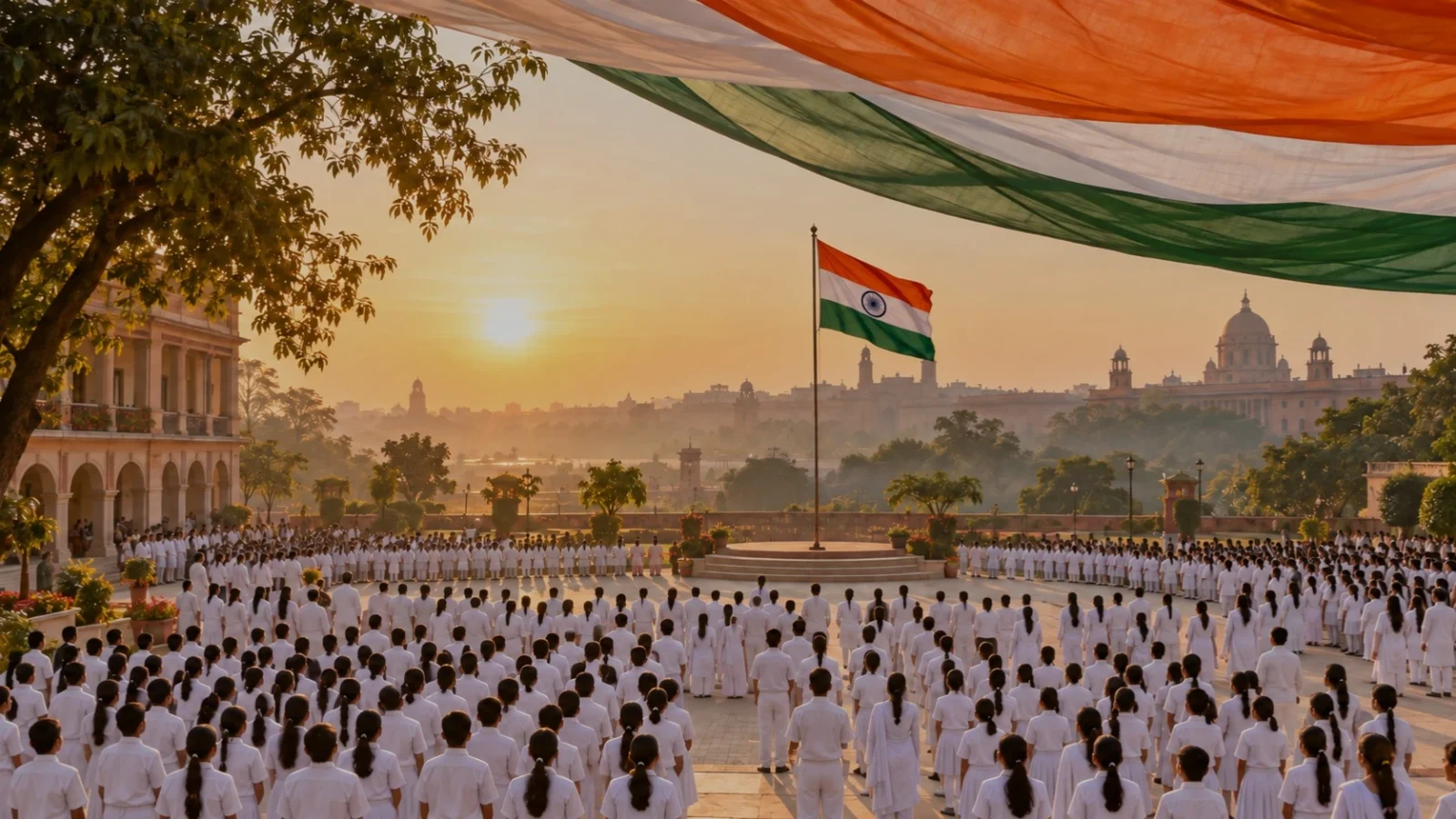
At 11 a.m. on September 25, classrooms, school grounds, community halls and public spaces across India are set to join in a common recitation of Vande Mataram. The programme, titled “Namami Bharatam”, has been organised by Vidya Bharati Akhil Bharatiya Shiksha Sansthan to commemorate 150 years of India’s national song.
Vidya Bharati says more than one crore students, teachers, parents and citizens are expected to participate at over 25,000 locations. The planned rendition is of the complete song. Schools are also holding discussions, exhibitions and cultural programmes on its place in India’s freedom struggle.
The scale is striking, but the date carries its own weight. Vande Mataram was written by Bankim Chandra Chattopadhyay and first published in the literary journal Bangadarshan on November 7, 1875. It later appeared in his 1882 novel Anandamath. Rabindranath Tagore sang it at the 1896 session of the Indian National Congress, and the words became closely tied to the Swadeshi movement after the partition of Bengal.
For generations of Indians living under British rule, the song was more than a composition. It was heard in processions, political meetings and student gatherings. Colonial authorities tried to curb its use in schools and public spaces, which only added to its place in the public memory. The cry of “Vande Mataram” carried a sense of belonging to the land, an appeal for self-rule, and a shared emotional language during a divided colonial period.
The title Namami Bharatam gives the September 25 observance a broader meaning. It is a salutation to India, expressed through collective remembrance rather than through a stage performance alone. For young participants, many of whom know the song chiefly from school assemblies or national days, the programme is intended to place the words beside their history: a Bengali literary work that travelled through India’s freedom movement and entered the country’s civic life.
Vidya Bharati has described the planned gathering as “One Voice, One Resolve, One India.” In Delhi, organisers expect more than one lakh participants at around 300 locations, with the principal programme scheduled at PGDAV College in Nehru Nagar. The event has also been listed with the Asia Book of Records and India Book of Records for certification as the largest simultaneous public singing of Vande Mataram.
Yet the anniversary arrives during a legal and public discussion over patriotism, personal conscience and the place of national symbols in a constitutional democracy. On September 22, the Supreme Court said a conscientious objector should not face criminal consequences for declining to recite one or all stanzas of Vande Mataram. The court is examining the issue after a petition by Carnatic vocalist T. M. Krishna and has asked the Centre to respond.
That distinction matters. A public commemoration gains dignity when participation comes from understanding and choice. The historical force of Vande Mataram lay in the meaning people attached to it during the freedom movement. Its 150th year offers an occasion to revisit that history with seriousness: the literature, the resistance, the emotion and the debates that have accompanied the song for more than a century.