
There’s something interesting about Google’s newest weather model, more than just its ability to better forecast tomorrow’s rain.
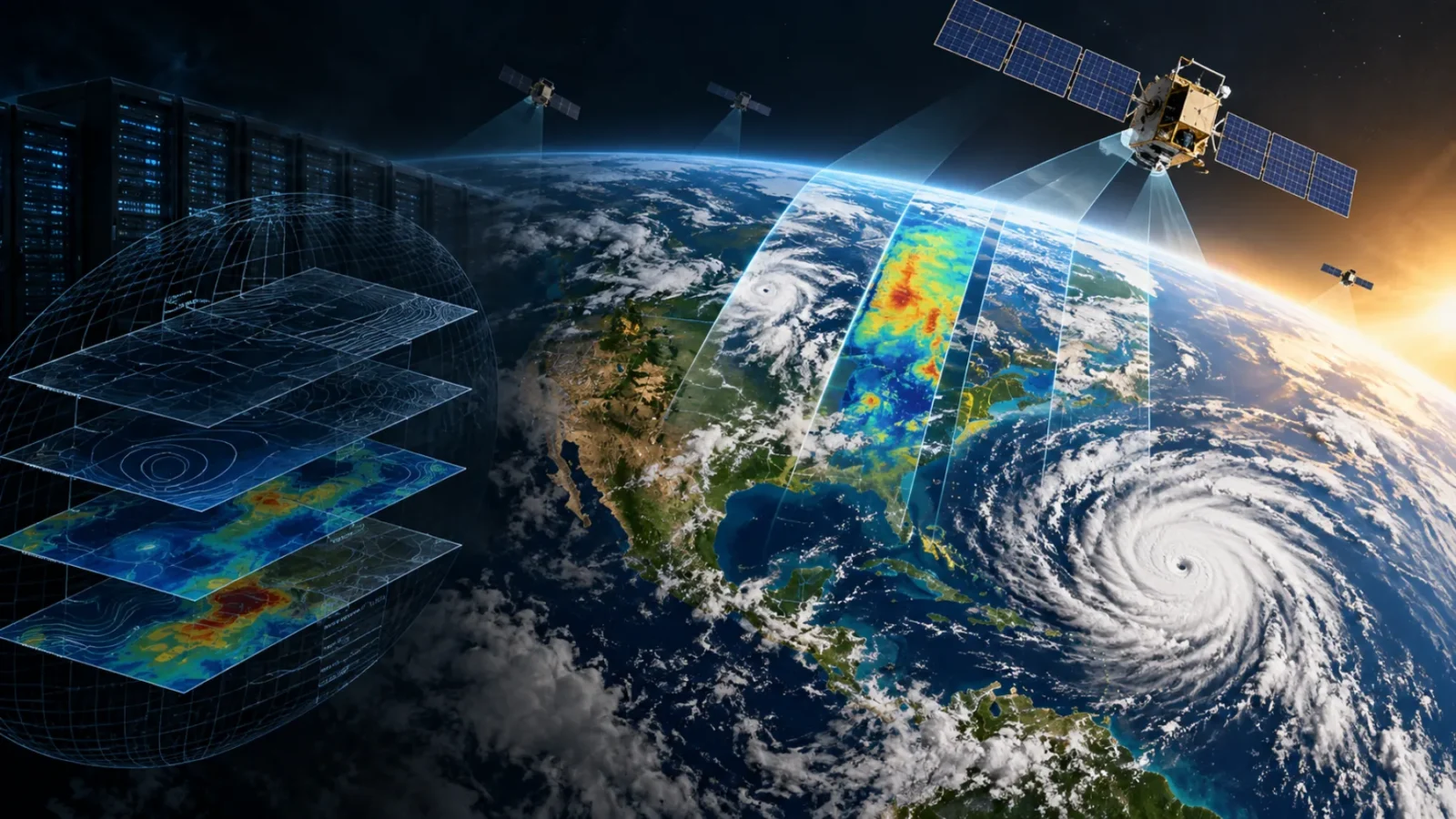
WeatherNext 3 suggests a more fundamental change in the way AI weather models are built. The model can directly ingest the recent satellite observations into the forecasting process, rather than only using the atmospheric states prepared by conventional numerical weather prediction.
This is not to say that numerical weather prediction is going to die. No, not at all.
But it does suggest we’re beginning to get a little fuzzy between looking at the atmosphere and asking an AI model what it’s going to do next.
This may even be more important than another accuracy leaderboard.
A strange dependence was found in the field of artificial intelligence weather prediction
There has always been a contradiction attending the arrival of AI forecasting.
Machine-learning models have been churning out sophisticated global forecasts at an astonishing clip. However, many of them still relied on the data produced by the numerical weather prediction systems against which they were being compared.
The process of traditional numerical weather prediction, or NWP, begins with the gathering of observations from a range of sources, including satellites, meteorological stations, aircraft, balloons, ships, radar, and other instruments.
These observations do not form a single, unambiguous picture of the atmosphere. They differ in resolution, uncertainty, timing, and location.
This information is fed into a measure of the current state of the atmosphere through the process of data assimilation. In the following, physics-based numerical models compute the probability of the state’s evolution.
It is one of the greatest engineering feats of modern science.
It also requires a huge computing infrastructure.
Artificial intelligence (AI) weather models revealed an alternative methodology. Machine learning systems learned patterns from large collections of historical atmospheric data but did not repeatedly solve the equations governing atmospheric motion for each forecast.
But there was a hitch.
Most of the data used to train and initialise these systems were numerical weather prediction analyses and re-analysis.
Google says past AI weather models, like WeatherNext 2, have used this type of analysis data.
So while the AI revolutionised the forecasting engine, much of the machinery that set up its starting point remained.
The procedure might be described as:
Weather observations Data assimilation Analysed atmospheric state AI forecast model Forecast
WeatherNext 3 starts to decrease this dependency. The satellite is on track for the forecast.
One of the biggest enhancements made to WeatherNext 3 is the use of low latency observations from geostationary weather satellites.
The model makes forecasts by stitching together a constantly updating mosaic of satellite and other data.
This allows WeatherNext 3 to generate a new global forecast every hour.
Google contrasts this with the 6-hourly update cycle common to many traditional, global forecasting systems and the analysis data used by previous AI methods.
This is especially true when the situation is changing quickly.
The six-hour-old view of the atmosphere can be a big limit when forecasting precipitation, surface temperature and rapidly developing weather patterns.
But the hourly refresh is just one part of the story.
One of the most fascinating changes is an architectural change.
AI forecasting is coming closer and closer to the observations themselves.
In the future a forecasting system might look like:
** Observations –> trained forecasting system –> probabilistic forecast
and that each stage be maintained as separate on a permanent basis:
Observations -> data assimilation -> numerical model -> processed atmospheric state -> AI model -> forecast
The transition to WeatherNext 3 is not complete.
It lives on in a meteorological ecosystem inherently linked to numerical models, analysis datasets, and decades of physics-based forecasting research.
But the gap between the observation and the predicted learned is narrowed.It is remarkable that the sharpness is fivefold. The pipeline modification is more important.
The resolution will certainly attract attention.
WeatherNext 3 provides higher spatial resolution for several surface variables, and provides hourly forecasts. Google says its global weather image is about five times more detailed than WeatherNext 2, which used a 25 km grid and was updated every six hours.
WeatherNext 3 can provide specific surface forecasts at a resolution of about 5 kilometres, while other variables are available at various resolutions.
The other big improvement is in precipitation.
Google reports up to 50% improvements on some probabilistic precipitation metrics relative to numerical-weather-prediction baselines compared to satellite derived observations.
That statement merits some thought.
That doesn’t mean every WeatherNext 3 forecast is “50% more accurate.”.
The finding is valid for specific probabilistic metrics, datasets, forecast horizons and comparison baselines.
Those are major developments.
But they may not be the most important feature of WeatherNext 3.
The more interesting question is: What roles is machine learning beginning to play in the forecasting pipeline?
WeatherNext 3 research paper expresses this with exceptional clarity. The model is a step beyond the usual phases of data assimilation, forecasting and post-processing in operational AI weather prediction, the researchers say.
This is a far more ambitious course of action.
The question is no longer so narrow as:
Can a neural network predict the weather?
There is a new kind of inquiry arising:
How many distinct steps are actually needed in a modern weather prediction system?
Could develop better unified learned system for forecasting the weather
Today operational weather prediction is not one model .
It includes a number of specialist systems.
Satellites observe the clouds and the state of the atmosphere. Ground stations monitor temperature, humidity and wind. Radar is used to track precipitation. Aircraft, ships and weather balloons are used for further observations.
Data assimilation brings together these measurements.
Numerical models progress the estimated state of the atmosphere in time.
Ensemble systems study uncertainty .
Other procedures correct biases, improve local detail, and convert the raw model output into useful forecasts.
The reason for those stages is the extreme difficulty of the physical, and computational problems involved in forecasting the weather.
AI may make some of the boundaries between those stages less rigid.
A sufficiently capable learned system may directly take in different types of observations, infer useful atmospheric information, and produce forecasts, while learning corrections previously associated with separate downstream processes.
WeatherNext 3 is interesting in that elements of that concept are now being implemented in a global forecasting system, rather than being isolated to research experiments.
Researchers have identified two limitations of earlier AI weather forecasting systems: their reliance on analysis data for training and initialisation, and their coarser spatial and temporal resolution compared to state-of-the-art physics-based models.
WeatherNext 3 directly addresses both.
That makes it more than just another entry in the contest for the most outstanding weather benchmark.
It’s a proof of concept of something we might call forecasting-stack compression. Compression of the prediction stack
In the history of software, there are many complex pipelines that have been simplified because machine learning can do things that were done by different components before.
Maybe we’re heading toward a similar era in forecasting the weather.
Rather than optimising each stage, researchers can explore whether a learned system can merge some of the functions that formerly required separate models and processing steps.
If this happens the consequences are much larger than the accuracy of the forecast.
Latency is variable.
A system that can use more recent observations can reduce the gap between the actual events in the atmosphere and the output of a forecast.
Calculate the economics change.
Training , data preparation , and the infrastructure to support it all can be very expensive . But running inference on a trained neural network can be * much * less computationally expensive than running a large numerical simulation over and over .
The update frequency has been changed.
The forecast can be updated more frequently, rather than relying strictly on a few major model cycles each day.
Finally, and perhaps most importantly, access was variable.
High resolution numerical weather prediction needs serious infrastructure and expertise. This can make sophisticated regional forecasts difficult or costly to run at locations with limited computational resources.
It becomes more feasible to distribute advanced forecasting if observation-driven artificial intelligence systems can produce high-resolution forecasts that are useful without each region needing to re-implement the whole traditional forecasting stack locally.
That would be quite a turnaround. Weather is becoming a live data layer
Another easy to miss change is the hourly forecasting.
Traditionally, weather prediction has been organised around the execution of model runs.
WeatherNext 3 is getting closer to a forecasting service that is updated on a continuous basis.
This difference is a lot more meaningful when forecasts are consumed by machines, rather than read by humans from time to time.
As conditions change, a logistics network could continually re-assess routes.
A renewable energy operator could provide updates throughout the day on expected solar and wind energy generation.
A change in the agricultural system could alter irrigation recommendations.
The probabilities of weather change could be used to inform the operational planning of airlines.
Weather can be treated as another live environment input to autonomous systems.
Google added variables specific to renewable-energy applications: solar information, for example, and wind conditions at useful heights for wind-energy forecasting.
This suggests some kind of wider transformation.
Weather forecasts are moving away from static reports toward a live predictive data layer that other software can query continuously.
Ultimately, this might be more important to companies than a better weather app on your smartphone. Numerical weather prediction is not a fad.
This does not spell the end of physics-based forecasting.
That conclusion would exceed the evidence presented by WeatherNext 3.
Rare events, unprecedented atmospheric conditions, uncertainty, operational validation and reliability are still challenging questions for AI meteorological systems.
Machine-learning models are trained on previous data. But the atmosphere can produce situations that are not adequately represented in that history.
One of the major advantages of physics-based models is the explicit constraint of their behaviour by equations of atmospheric processes.
This is especially important in operational meteorology where forecasts can have a large impact on public safety, energy systems, aviation, flood warnings and evacuations.
Weather agencies can’t just throw out their existing forecasting infrastructure because a new model performs well on a benchmark.
“New systems must be able to work reliably in all regions, all seasons, all extreme events and all unusual conditions.
Thus, WeatherNext 3 should be viewed as an element of a new forecasting framework rather than as a replacement for numerical weather prediction.
It is unlikely that the near future will be:
NWP gets replaced by AI.
The more likely result is:
AI takes over parts of the pipeline, numerical models are kept where operational reliability and physics bring a unique value, and hybrid systems are built on both strengths.
The competition is more fun than knowing who wins one benchmark. Cyclones have already given a hint
The direction was clear even before WeatherNext 3 was released.
Google DeepMind has been extending AI weather prediction to places where the real-world relevance of speed and detail is direct and great, such as tropical cyclone forecasting.
Cyclones are an especially demanding test.
Small advances in track and intensity forecasting can make a big difference in evacuation, emergency response, port, aviation, and infrastructure decisions.
Time is important.
WeatherNext 3 expands the AI-weather initiative to bring a globally refreshed forecasting capability.
This development suggests that AI weather research has moved beyond the question of whether machine learning can generate competitive forecasts.
Researchers are looking at how much the forecasting process can be reengineered. Accuracy may not be the only important criterion anymore
For years, the main way to talk about AI atmospheric systems has been through comparisons to numerical models.
Which system has the lowest error rate?
Which method is better for forecasting storms?
Which approach produces a forecast faster?
Those questions continue to matter.
But the next generation of weather AI may require a different set of metrics.
What is the amount of observational data that a model can directly make use of?
How much time elapses between the time a new satellite observation arrives and the time a useful forecast can be made from it?
How many conventional processing stages are left?
How can the system most efficiently generate a probabilistic ensemble?
How does it perform in situations that differ from those it was trained on?
How much does it depend on the analysis results produced by numerical models?
And what does it cost to operate globally?
Those enquiries tell you things that an accuracy leaderboard doesn’t.
They tell us whether AI is just evolving into a more accurate way to generate a familiar weather forecast, or whether it is beginning to create a different kind of computing architecture for forecasting the weather.
The second possibility is supported by preliminary results from WeatherNext 3.
The most important progress in AI weather prediction may therefore not come in the form of a competition in which neural networks eventually win out over atmospheric equations.
Something subtler is going on.
The lines between watching the atmosphere, trying to guess what it’s like now and forecasting what’s going to happen next are starting to blur.
If that trend continues, WeatherNext 3 could end up being remembered for something bigger than sharper forecasts.
This may be a milestone for researchers re-evaluating the basic needs of a weather prediction system.