Google Cloud on November 10, 2026, unveiled Gemini for healthcare, extending its enterprise Gemini agent to hospitals, medical groups, health insurers, and other healthcare organizations. The service is now in preview in the U.S. and is intended to help prepare patient records, organize insurance authorization requests and get coverage information from the systems that healthcare pros already use.
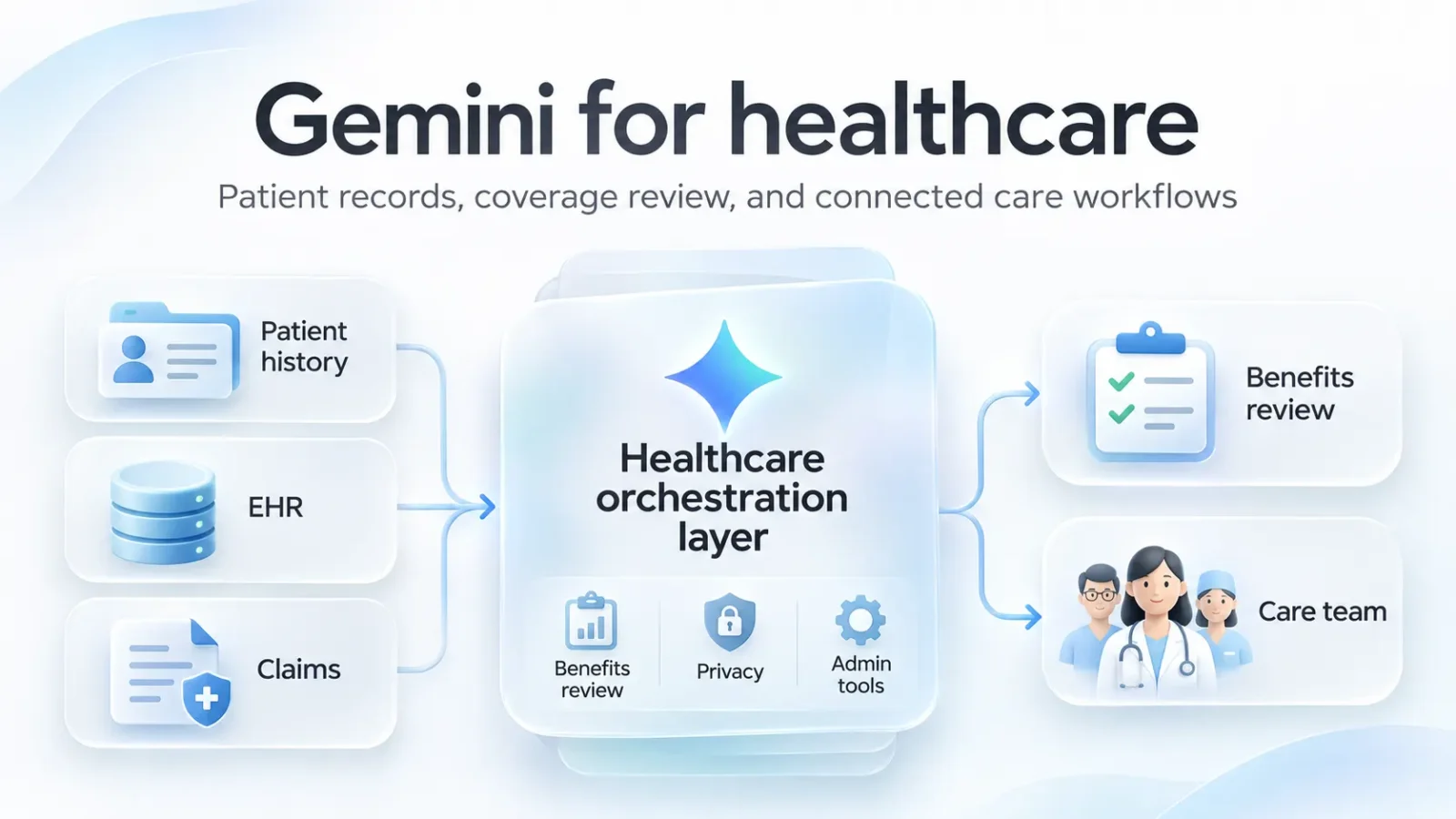
Launched in October by Google Cloud CEO Thomas Kurian, the product builds on the universal Gemini agent with healthcare-specific instructions, connections to clinical data and administrative tools. Google has no plans to require organizations to replace their electronic health record or claims software, but instead Gemini is meant to help coordinate work across these applications, with human supervision of clinical and coverage decisions maintained.
Patient Records – Clinical Appointment Preparation
Medical histories often are not kept in one system. If a patient’s medications, diagnoses, lab results and reports from specialists are spread across hospitals, clinics and outside care providers, clinicians may need to piece the information together before deciding on a course of treatment.
Gemini for healthcare is designed to compile authorized records and arrange them into a chronological patient history. It can tell the difference between active and resolved problems, catch any medication mismatches and pull together the right clinical data for you to look at.
Looking over your medical history is not the only part of preparing for an appointment. Gemini, says Google, can check for upcoming appointments for missing lab results, needed clearances, pending consent forms, and any changes since the patient’s last visit. The care teams can look over the collected material before the patient’s appointment, so they don’t have to scramble through a variety of applications during the appointment. The consolidated record is only as good as its source material, thus requiring clinical verification. Professional review is still necessary to reconcile conflicting medication information, incomplete histories and out-of-date documents before they affect patient care.
Insurance Coverage and Authorization Reviews
Authorization of an insurance claim usually involves matching medical records against the coverage policies of a health plan. Insurance reviewers check if a request fits the criteria in the applicable policy, and providers must send in paperwork to support their request.
Gemini assists you in assembling clinical evidence into an authorization packet, comparing the documentation against payer requirements, and identifying missing information before sending it. The system can also write an appeal if a request is denied and there is enough evidence to support an appeal, using the patient’s clinical record and the correct insurance policy.
It provides a related set of functions to health plans. Incoming requests can be categorized based on medical policies for clinical reviewers, with supporting records and policy references available for verification. The goal of the approach is to reduce the time needed to find evidence, without shifting the ultimate coverage decision to an AI system.
Member services teams can use Gemini to interpret insurance documents and explain deductibles, network eligibility, and estimated patient expenses. This can be helpful in the financial details for a person considering a medical procedure before treatment. However, an estimate does not guaranty the final bill, since actual costs depend on the services provided and the member’s coverage.
Salesforce, Optum, Epic and Other System Integrations
A significant portion of Gemini is its capacity to integrate with existing software in healthcare organizations. The connector ecosystem that Google recently announced includes Epic, Oracle Health, Optum, Salesforce, InterSystems, TriZetto and other providers that specialize in administrative operations, insurance information and clinical records.
Epic and Oracle Health integration allows authorized users to view existing patient information without having to reenter changes into the original medical chart. This read-only design allows Gemini to pull clinical context while leaving the electronic health record, the system used to maintain official patient documentation.
Although Optum connections handle insurance eligibility and benefit coordination, Google has tagged certain Optum integrations as limited release and testing. Coverage resources can provide published Medicare policy references: Centers for Medicare and Medicaid Services . Salesforce Health Cloud connects clinical and operational workflows.
Different organizations will need different combinations of these connections. The implementation process should take into account the availability of connectors and the current access permissions. The needs of a hospital that collects records from multiple care settings differ from the needs of an insurer reviewing authorization requests.
How Gemini coordinates health care work
Gemini for healthcare combines centrally managed controls, implementation partners, software connectors and reusable healthcare instructions. Organizations can use their own procedures to develop instructions for activities such as preparing charts, checking medical policies, and determining benefits to define what information to gather and how to do the work.
Google also supports the use of different AI models for different tasks. Models selected for lower running costs could be employed for routine administrative tasks and those more appropriate for duties where more detailed analysis is required could be allocated.
One major technical difference is that Gemini is designed to collect evidence and perform authorized administrative procedures, rather than to act as an independent medical authority. Google details the source citations, activity logs and access restrictions that allow authorized reviewers to see the information that goes into an output.
HIPAA Requirements and Protecting Patient Data
Healthcare organizations work with information that should have stringent restrictions on disclosure, storage and access. “Gemini for healthcare operates within an organization’s governed environment, respects existing user permissions and includes security controls designed to help meet Health Insurance Portability and Accountability Act, or HIPAA, compliance,” Google says.
Google has said its foundation models are not trained or fine-tuned on clinical records, prompts or generated results. Audit trails and source references are intended to be used by clinical and compliance teams to review how information is acquired and used.
Not every deployment supported will automatically be HIPAA compliant. US Department for Health and Human Services guidance requires healthcare organizations using cloud services to process protected health information to comply with the relevant regulations, including business associate agreements and appropriate risk assessments. Those duties still apply when integrating Gemini into patient data workflows.
Health care organizations in development
Google collaborates with organizations including HCA Healthcare, Northwell Health and Blue Cross Blue Shield of Massachusetts on healthcare applications. They say they want to combine medical histories across settings of care, reduce administrative burdens on caregivers and build reusable AI functions for health plan operations.
As part of the effort, Google has also named groups such as the American Society of Clinical Oncology and Optum. Their involvement provides examples of the clinical, insurance and research activities under consideration but should not be taken to mean that all announced functions are deployed across those organizations.
preview availability in the U.S. and future developments
Gemini for healthcare now available in preview for healthcare enterprises in the U.S. Google has not publicly provided a general availability date or pricing for the service, and its launch announcement does not include independently verified performance indicators for the entire healthcare product. The actual results will depend on the quality of linked records, availability of supported integrations and reliable verification of generated information against clinical evidence and insurance regulations. Healthcare organizations reviewing the preview will need to decide whether it reduces the time needed for preparation and review, while maintaining accurate documentation and appropriate professional supervision.
Google’s approach places AI in the middle of the systems that now have patient records, coverage rules and administrative information. Its practical value will come down to whether clinicians and insurance teams can do the necessary work with fewer manual steps without losing the ability to verify the information behind each decision.