
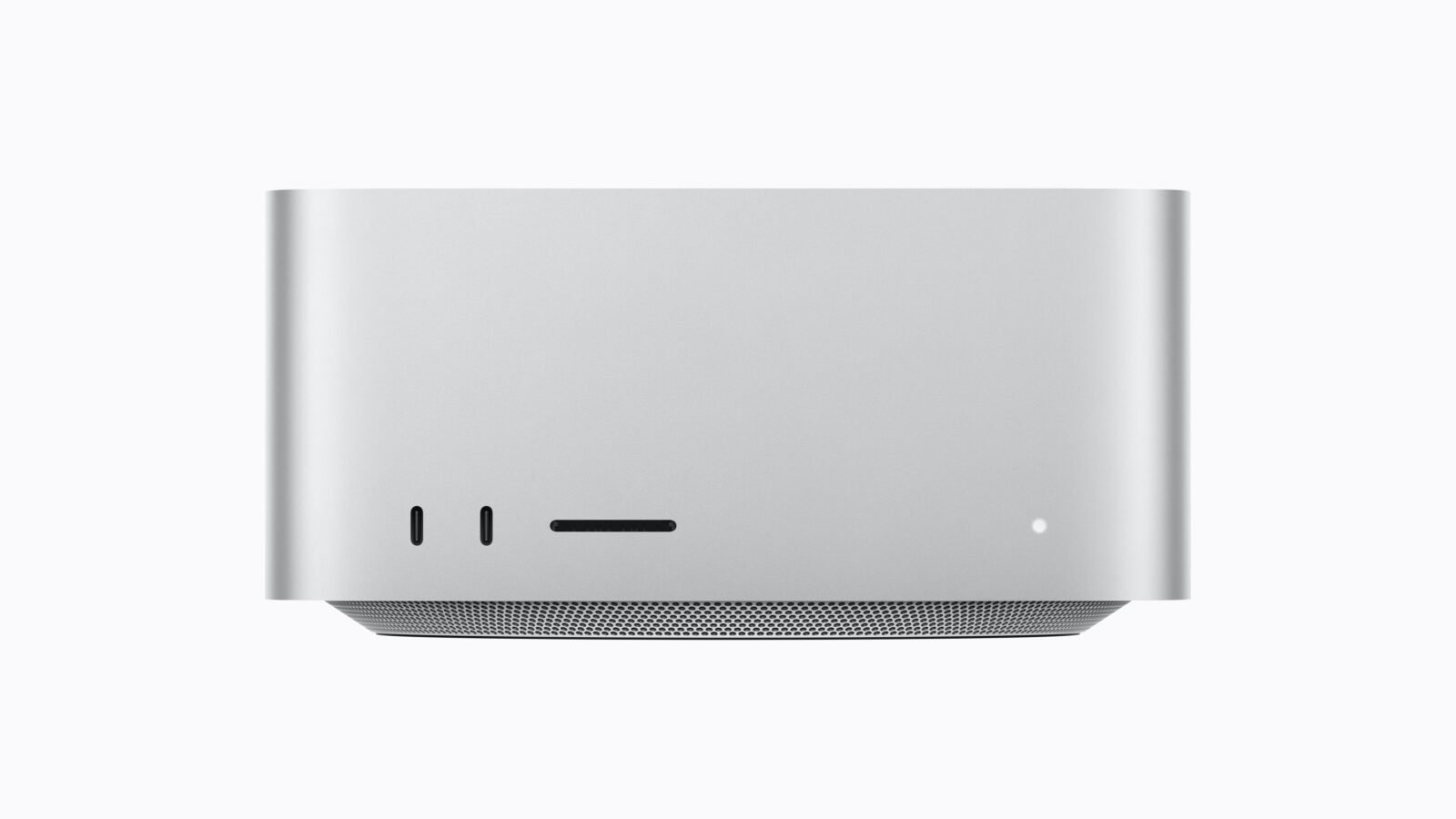
Apple built two computers this week that are meant to run AI models entirely on their own hardware. Not a cloud subscription. Not renting time on somebody’s server rack. Just your desk, a chip, and a model doing its thing right in front of you.
That’s a bigger deal than the headlines are giving it credit for. Everyone in AI has spent the past few years assuming bigger wins, more servers, more racks, more cloud spend. A good chunk of developers already stopped buying that idea, quietly, on their own time. Apple just handed them better tools to keep proving it.
What’s actually new under the hood
Start with the M6 chip in the new Mac mini. First Apple processor built on a 2 nanometer process, which sounds like a spec sheet footnote until you realize what it buys you, more transistors packed into less space, real performance gains without the power bill climbing to match. Apple’s claiming close to double the AI throughput compared to last year’s chip, thanks to a dual 16 core Neural Engine. Graphics got faster too, around 30 percent by their own numbers. Want more power? There’s an M5 Pro version.
Mac Studio is where I stopped skimming and actually paid attention. It ships with either an M5 Max or a new M5 Ultra, which Apple says is the most powerful chip it’s ever shipped. Here’s the detail that got me: link a few Studio units running the Ultra chip together and they share memory across machines, acting like one giant computer that can run models with a trillion parameters. That used to require a server room. Now it’s something you could fit under a desk.
Developers got here before Apple did
None of this snuck up on people actually building AI tools. Engineers writing autonomous agents, software that runs tasks without someone babysitting it, have been buying up Mac minis for close to a year already. Makes sense why. Cheap, small, runs fine without a monitor plugged in, leave it on a shelf grinding away at background jobs all day. Teams working with agent frameworks like OpenClaw specifically chose dedicated mini setups so their work stayed off someone else’s servers.
Researchers gravitated toward Mac Studio for similar reasons, mostly people fine tuning their own models rather than renting cloud GPUs. Apple’s unified memory setup helps here too, CPU, GPU, and Neural Engine all pulling from one shared pool of RAM instead of passing data between separate chips. Fits this kind of workload naturally. Half the reason Apple silicon has a name in AI circles has nothing to do with editing photos or browsing the web.
Pricing, and what it actually buys
New Mac mini starts at 899 dollars, M6 chip, 16GB memory, 256GB storage. Need more? M5 Pro starts at 1,699. Mac Studio holds its M5 Max price at 2,499 dollars, fair given what it can do, and the M5 Ultra opens a new tier at 5,499. Want the fully loaded 512GB memory version? You’re waiting until late October.
Memory and storage have gotten pricier across the board, mostly thanks to AI data centers eating up supply. Apple points to that as part of the reason behind these numbers. Fair enough, considering that’s the same demand making this hardware worth owning in the first place.
Why this matters more than it looks like it should
Apple just gave people a real alternative: get serious AI capability without shipping your data, or your compute bill, off to someone else’s cloud. Not everyone’s convinced hyperscale infrastructure is the only road forward, and now there’s actual hardware backing up that opinion. Apple doesn’t run its own major cloud AI platform. It doesn’t need one. It already controls the chips sitting inside a massive share of the world’s desktops and laptops, and this launch says plainly that it plans to use that.
Most people picking up a Mac mini this fall just want a faster everyday computer, and that’s a perfectly good reason to buy one. But if you’re a developer or researcher who already built a workflow around Apple silicon, this refresh confirms what you probably already figured. Apple’s paying attention to how people actually use its hardware, and it’s willing to reshape an entire product line around something that barely existed five years back.
Both new Mac mini and Mac Studio configurations are up for pre order now. Most units ship September 22.