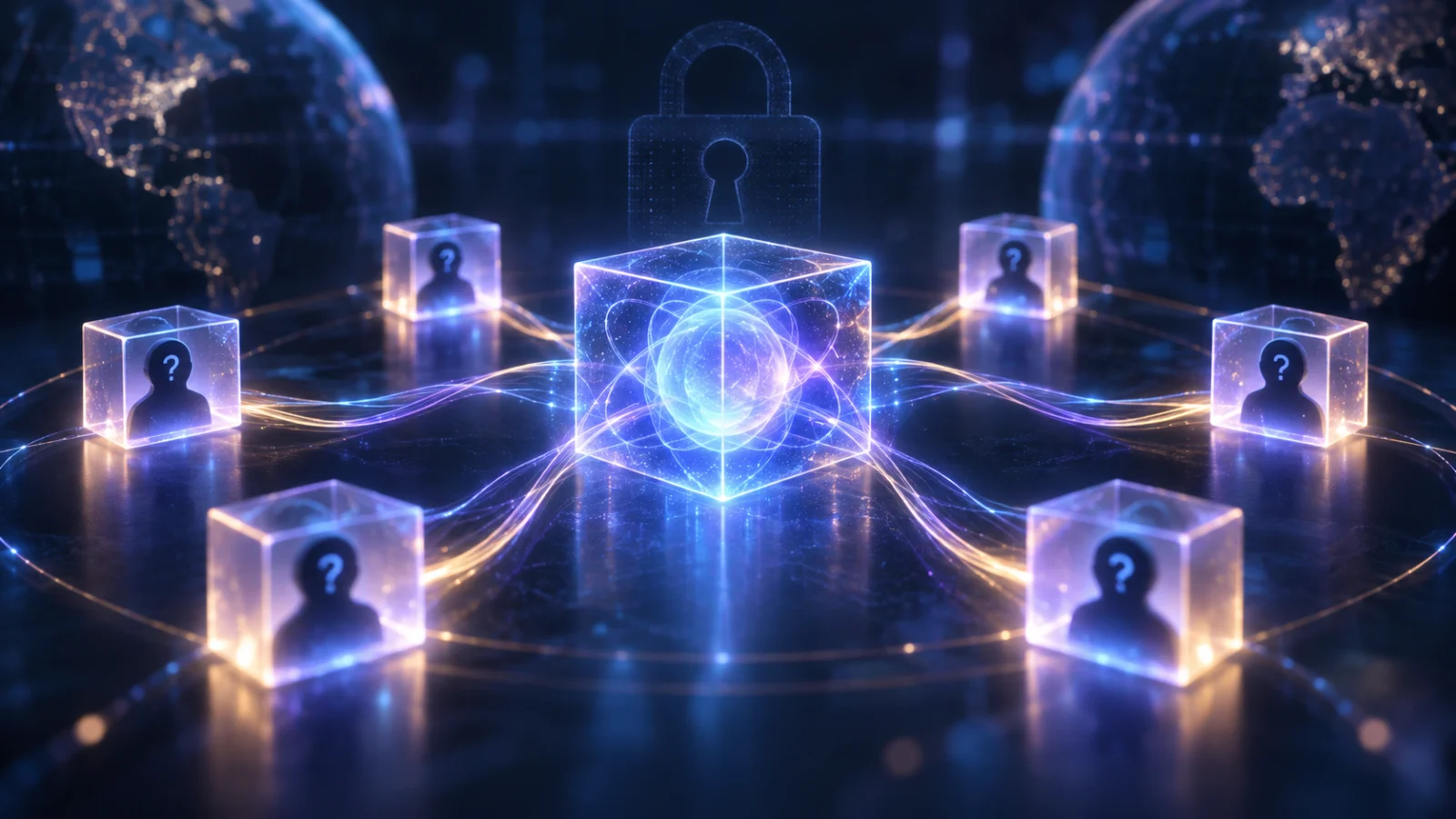
Quantum cryptography is founded on information security. Varin Sikand and Andrew Nemec take the question a step further: what if the secret is protected but the network reveals who helped to recover it?
In 2026 they wrote a paper on Quantum Anonymous Secret Sharing with Permutation Invariant Codes . They discuss quantum secret sharing with anonymity of sender at the decoding stage . This is important because future quantum networks may need to protect not only the state being transmitted but also the identity and role of the participants.
Hiding the sender, not just the secret
Secret sharing distributes sensitive information among a number of participants, which can be reconstructed only by an authorised group. Quantum secret sharing is the same idea for quantum states.
The privacy issue is that the reconstruction can still identify the donor of a particular share. The secret might be locked out for outsiders . The participant identity might be revealed by the protocol itself .
Sikand and Nemec go directly for that gap. They are built from quantum transmission that is anonymous, and permutation-invariant quantum error-correcting codes.
Permutation invariance: why it works
Permutation-invariant codes have a useful symmetry: any reordering of the physical subsystems leaves the encoded codeword invariant.
This makes them especially interesting for anonymity. This information is not linked in the normal manner to a specific ordering of physical components, which helps to diminish the identifying structure around individual shares.
This is one of the strongest parts of the work. A property usually associated with quantum coding is integrated into the privacy design.
Quantifying Information Leakage
The paper also goes beyond the anonymity.
As a consequence, in ramp quantum secret sharing some groups may have too few shares to recover the secret, but still have partial information about it. In the intermediate cases, Sikand and Nemec study the amount of information that can leak using quantum conditional min-entropy.
They connect this measure with the Knill-Laflamme quantum error-correction conditions, thus providing a solid theoretical basis for the leakage analysis.
That matters because security is not often a choice between “nothing revealed” and “everything revealed.” The learnability of intermediate groups enables investigators to have a more realistic comparison of secret sharing schemes.
Why this is important for quantum networks
Quantum networks in the future will bridge universities, corporations, governments, data centers or quantum processors in different locations in space.
In such environments participation itself may leak sensitive information. Even if the quantum payload is kept hidden, knowing which node contributed a share could reveal authority, relationships or operational roles.
Metadata is already proving useful in classical cybersecurity. Encrypting a message does not automatically hide who sent it, who received it, or how participants are connected.
The same basic problem will appear in a different guise for quantum systems.
A helpful three-way intersection
In their paper, Sikand and Nemec combine three topics that are usually treated separately: quantum error correction, quantum secret sharing and anonymous quantum communication.
That combination is what makes the paper unique.
Quantum error correction shields fragile states. Secret sharing controls who can assemble them. Anonymity ensures that participants’ identities remain protected.
The fact that we can bring those properties together in a single construction reflects the way in which future quantum infrastructure will likely have to operate: reliably, selectively and privately at the same time.
Participation itself may require protection by privacy
The bigger lesson is that quantum privacy may not be about safeguarding the state.
A distributed quantum operation also provides information on who participated, who cooperated and which nodes were involved. That pattern of participation can itself be sensitive.
Sikand and Nemec do not claim to solve every anonymity problem in quantum networks. Their work is more focused and thus more useful: they identify a particular privacy vulnerability, propose a structured way to deal with it and provide a method to analyse information leakage.
That is a valuable contribution.
Eventually, quantum networks will carry more than just qubits. They will also have relations and patterns of cooperation. Protecting those relationships may be as important as protecting the quantum information itself.
About the research
Paper: Quantum Anonymous Secret Sharing with Permutation Invariant Codes
Authors: Varin Sikand and Andrew Nemec
Submitted: April 30, 2026
arXiv: 2604.27284
Editorial note
This article is an independent TechSota analysis of research by Varin Sikand and Andrew Nemec. The underlying protocol, mathematical construction and research findings are credited to the authors. TechSota is not affiliated with or endorsed by the researchers or arXiv.