
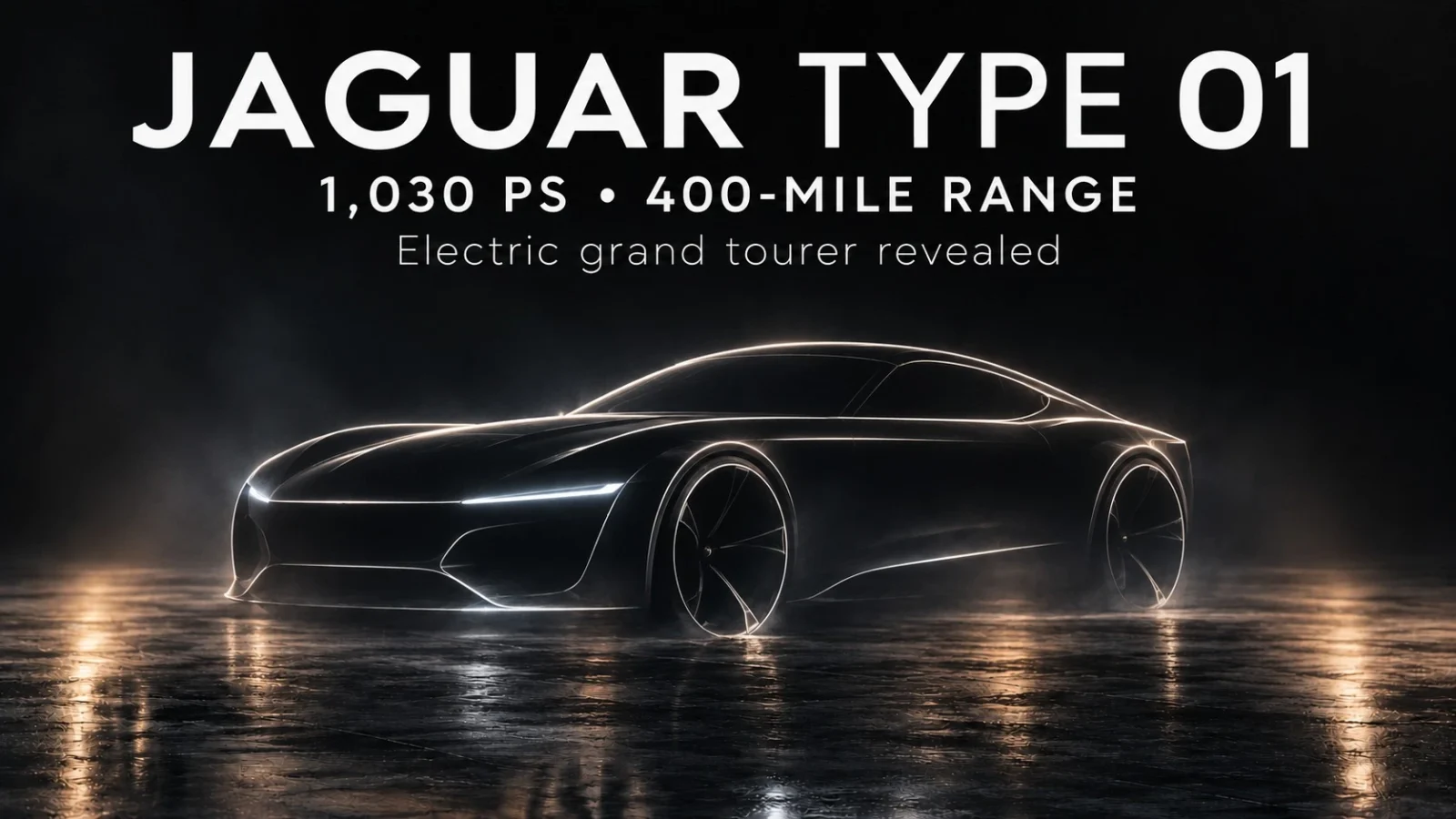
Production specs have finally been revealed for Jaguar’s new electric car. After almost two years of concept images, prototype sightings and debate over Jaguar’s reimagining, the production Jaguar Type 01 made its global debut in New York on October 6, 2026. The technical details were released by JLR on October 7.
The Type 01 is a four-door electric grand tourer with a 118 kWh usable battery providing up to 1,030 PS and 1,365 Nm of torque, with a projected EPA driving range of up to 400 miles. Jaguar has mated that battery to an 850-volt electrical system and 350 kW DC charging. Production starts in the UK in 2027. This is also Jaguar’s first production car since the much-talked about brand reset. The design concept was Type 00, which appeared in Miami in December 2024. Type 01 is what the car customers will actually be able to order.
Type 00 and Type 01 are not the same Jag.
The names are close enough to cause confusion, particularly for anyone looking for a new Jaguar electric car, Jaguar Type 01, Jaguar 01 or just the new Jaguar EV. Type 00 was a design study that never went into production. Jaguar used it to demonstrate the proportions and visual ideas it is planning for its upcoming electric cars. Its long bonnet, low roof, 23-inch wheels and unconventional rear treatment pointed the way without being offered for sale. Type 01 brings that thinking to the road car.
The new name is explained literally by Jaguar. The “Type” ties it to names from Jaguar’s past. The zero is for zero tailpipe emissions. The one marks it as the first production vehicle in this generation of Jaguars. This distinction makes Type 01 far more than just another concept car showing. Now the design has a battery size, charging figure, power output, price, factory and customer-delivery schedule attached to it.
The production car retains the long-bonnet proportions
In an electric car, the packaging usually allows for more design freedom in the front part of the car, since there is no large combustion engine in front of the passenger compartment. Jaguar has used that freedom in a different way.
Type 01 features a low roofline, short front overhang, very long bonnet and extended rear section and 23-inch wheels. Rather than squeeze the car visually around its electric hardware, Jaguar has stretched the shape out into the proportions of a traditional grand tourer. That is one reason why the Type 01 does not immediately look like the usual electric luxury sedan.
The body is also said to have a drag coefficient of 0.23. Active vanes and a three-stage deployable rear spoiler help manage airflow around the car, and Jaguar uses… “JLR says this is the most aerodynamic Jaguar they’ve ever made. The production Type 01 has no traditional rear window, another feature carried into Jaguar’s unusual approach to the back of the car, Reuters reports.
And there is an engineering tension here that makes the Type 01 especially intriguing. The big 23-inch wheels and dramatic body proportions give designers the stance they wanted, while the aero devices and low 0.23 drag figure work in the opposite direction by controlling the energy lost to the air at speed. That gets even more relevant for a car being marketed as a long-distance electric GT.
Jaguar Type 01 Specifications
JLR’s October 7 technical release gives the first detailed picture of the Jaguar Type 01, including its electric powertrain, battery capacity, estimated driving range, charging performance and launch schedule.
| Specification | Jaguar Type 01 |
|---|---|
| Vehicle type | Four-door electric grand tourer |
| Architecture | Jaguar Electric Architecture (JEA) |
| Motors | Three-motor electric system |
| Maximum output | Up to 1,030 PS |
| Maximum torque | Up to 1,365 Nm |
| 0–62 mph | From 3.2 seconds |
| 62–112 mph | 4.0 seconds |
| Battery | 118 kWh usable |
| Electrical system | 850 volts |
| EPA range estimate | Up to 400 miles |
| WLTP range estimate | Up to 450 miles / 720 km |
| Sustained 75 mph highway range | Up to 320 miles |
| Maximum stated DC charging | 350 kW |
| Rapid-charge range claim | Up to 200 miles / 321 km in 13 minutes |
| Weight distribution | 50:50 |
| Wheels | 23 inches |
| Drag coefficient | 0.23 |
| UK starting price | £130,000 |
| Orders | Early 2027 |
| First deliveries | Second half of 2027 |
Range figures are still estimates from the manufacturer pending final certification. Jaguar also says charging performance depends on battery temperature, battery condition, initial state of charge and the charger being used.
Three electric motors with over 1,000 PS
The Jaguar Type 01 electric car is powered by three motors and Jaguar’s torque-vectoring system. Peak power is 1,030 PS and 1,365 Nm is available. Jaguar says it can hit 62mph from zero in 3.2 seconds.
Perhaps more revealing is the acceleration after the launch is done. Type 01 can reportedly go from 62 mph to 112 mph, or 100 km/h to 180 km/h, in four seconds. That number indicates that Jaguar has been busy trying to keep up a good pace of acceleration well past city-driving speeds rather than just the familiar EV zero-to-60 headline.
Jaguar also claims to have used knowledge from its Formula E program in the development of the driving characteristics and to give the car a 50:50 weight distribution. So the car is being designed around the classic grand-tourer brief: high-speed travel, big reserves of power and sufficient battery capacity for long journeys. It just happens to be coming up on that brief without an engine.
The GT mission has a 118 kWh battery,
There is a lot of energy under the Type 01, with a usable battery capacity of 118 kWh. Jaguar claims a range of up to 400 miles in the EPA cycle and up to 450 miles or 720 km in WLTP testing. JLR also gives one unusual extra figure: up to 320 miles on a constant cruise at 75 mph (120 km/h).
It is sensible to publish a constant-highway-speed estimate for a grand tourer. Driving on the expressway can reveal the difference between the optimistic range shown in the laboratory and the distance an EV can travel for hours on end through thick air. Before buyers can tell how close production cars are to those estimates, independent testing will be required.
Jaguar quietly changed the range target from Type 00
One other detail that deserves to be separated out from the launch day numbers. Jaguar announced the Type 00 in December 2024, saying that the upcoming production GT was targeting up to 430 miles EPA and 770 km WLTP. The completed Type 01 now has an expected 400 miles by the EPA and 720 km by WLTP.
The rapid-charge one went the other way. Jaguar’s 2024 Type 00 announcement talked about adding 200 miles in about 15 minutes. Type 01 now delivers 200 miles at an astonishingly fast 13 minutes with a 350 kW DC charger.
That is a much more useful comparison than pretending the concept-car numbers are the final specs. Jaguar has gone from the early targets to numbers that are tied to the production car, but the final certified range is still to come.
Why Jaguar used an 850 volt electrical system
Hundreds of kw fast charging produces a lot of current and heat. The higher the system voltage, the less current is required to transmit a given amount of electrical power than a lower voltage design. Type 01 has an 850-volt architecture and supports charging to 350kW.
Jaguar says that with the right charger, you can get as much as 200 miles or 321 kilometers of stated range in 13 minutes. That doesn’t mean that every 13-minute pit stop will add 200 miles. Result is affected by battery temperature, starting percentage, charger output and the vehicle’s charging curve.
For buyers who are going to do a lot of expressway driving the full charging curve will be more useful than the headline 350 kW number eventually. That entire curve was not included in the October 7 material from Jaguar. That’s one spec worth revisiting once independent testing gets underway.
Inside, one 24-inch display takes center stage
Jaguar hasn’t crammed the Type 01 dashboard with a row of separate screens. The driver gets a 24-inch OLED display with single-glass construction running Jaguar’s new infotainment interface. A separate seven-inch touchscreen for frequently used controls is positioned between driver and front passenger.
A central spine runs through the cabin dividing the interior into four individual seating areas. Long visual themes from the exterior of the car are continued inside with brass-effect anodized aluminum running the length of the cabin. The audio is also treated unconventionally. For the Type 01 sound system the Jaguar has developed a full-width Panoramic Soundbar and Sensory Audio seats.
Those decisions make the cabin worth following beyond the launch photos. Until production cars are in the hands of reviewers, you can’t judge screen responsiveness, menu structure, rear visibility, seating position and everyday ergonomics.
The car is behind more than 360 patent applications
JLR says work on Type 01 has resulted in more than 360 patents. Wording matters. This is patent applications not a claim that 360 patents have been granted already.
Jaguar has created a bespoke vehicle architecture, rather than working from an existing combustion-car base. JEA gives engineers the freedom to choose the location of the battery, electric motors, passenger compartment and structural elements, while allowing designers to retain the long bonnet and low silhouette.
“This is one of the most technically interesting bits of the new Jaguar car. The electric packaging allows many EVs to have shorter nose and more passenger space. Jaguar deliberately selected an alternative visual ratio. The car therefore uses electric architecture to recreate the visual drama associated with older Jaguar GTs rather than trying to advertise its electric drivetrain through a stereotypical EV shape.
Type 01 will be built at three UK locations
Production at JLR’s Solihull plant will begin in 2027. The manufacturing chain doesn’t stop at Solihull. Electric Drive Units and battery packs will come from Wolverhampton, while pressed body panels will be produced in Halewood, Merseyside. JLR says nearly 9,000 Solihull employees have been retrained for electric-vehicle production, with another 1,500 trained elsewhere in its West Midlands operations.
This gives the new electric Jaguar a very British manufacturing footprint even as Jaguar puts more commercial emphasis on North America. North America is a key growth market for JLR, according to the carmaker. Jaguar is going all-electric, while Range Rover, Defender and Discovery will continue with a broader mix of powertrains.
What is the price of the new Jaguar Type 01?
JLR has set a UK starting price of £130,000. Orders are expected to open in early 2027, with first customer deliveries in the second half of the year. The New York premiere was followed by a starting price in the United States of $130,500, Reuters reported.
Based on the pricing, there can be no doubt about where Jaguar wants the car to sit. We are not presenting the Type 01 as an alternative for a budget electric sedan or crossover. It is being touted as a luxury GT and as the first product around which Jaguar plans to rebuild its model line.
The New York setting also works better in that context. Reuters says JLR sees opportunities to grow in the US even as demand for fully electric luxury cars has had mixed results across the industry.
The most interesting tech is not the 1,030 PS figure
Four-figure power outputs are a headline grabber, but the Type 01 is more fascinating as an insight into how Jaguar thinks an electric GT should work. The purpose-built architecture gave Jaguar the freedom to take proportions that would seem odd for an EV designed with cabin efficiency as a primary goal. The usable battery is 118 kWh, giving the range you’d expect of a GT. The 850-volt electrical system and 350 kW charging target are meant to reduce the number of stops needed on long trips. Active aerodynamic bits help a big car on 23-inch wheels achieve a claimed 0.23 drag coefficient.
Those pieces have been designed around the same job, not around one acceleration number. It’ll be interesting to see what independent testing shows for the 320-mile estimate at a steady 75 mph. A verified figure close to that would say far more to buyers about the utility of the Type 01 as an expressway GT than any launch-control demonstration.
Jaguar Type 01 vs Type 00
The production car also provides us a rare opportunity to compare an EV concept with the production vehicle that followed. Type 00 took care of the long bonnet, low roof, large wheels and unconventional rear treatment. Type 01 kept a lot of that visual thinking and added four usable doors, production engineering, a certified-car program and a real customer timetable.
Along the way, the numbers changed. Jaguar reduced its original 2024 range targets from 430 EPA miles to 400 EPA miles, and from 770 km to 720 km WLTP. The claimed time to add 200 miles of range improved from 15 minutes to 13 minutes.
That is precisely what should occur between a concept program and a production specification. Early targets meet crash requirements, battery packaging, thermal limits, aerodynamics, tires, software, durability testing and manufacturing reality. Type 01 is now close enough to production that those numbers have a practical meaning.
When is the new Jaguar electric car to be released?
Jaguar is expected to start taking orders for the Type 01 in early 2027. JLR expects the first customer deliveries to be in the second half of 2027, with vehicles built at Solihull in the UK.
Production cars still have final range certification and independent road tests need to establish energy consumption, charging behavior, ride quality and usable real world range. But for the first time since the Type 00 Jaguar’s electric revival can be talked about as a car and not as a design exercise.
We know the battery now. Usable: 118 kWh. We know the power, up to 1,030 hp. We know the EPA advertized range: Up to 400 miles. The charging goal is known: 200 miles in 13 minutes at up to 350 kW. We know what the entry price is in Britain: £130,000. And we know when customers are supposed to get one: second-half 2027.
The first independent road tests will answer the questions Jaguar can’t answer on a spec sheet. The first delivery figures will answer another question: how many buyers want Jaguar’s return to start out with an expensive, 1,000-plus-PS electric grand tourer. Type 01 is now a real product with measurable claims for Jaguar. That makes 2027 much more interesting than the launch campaign that preceded it.