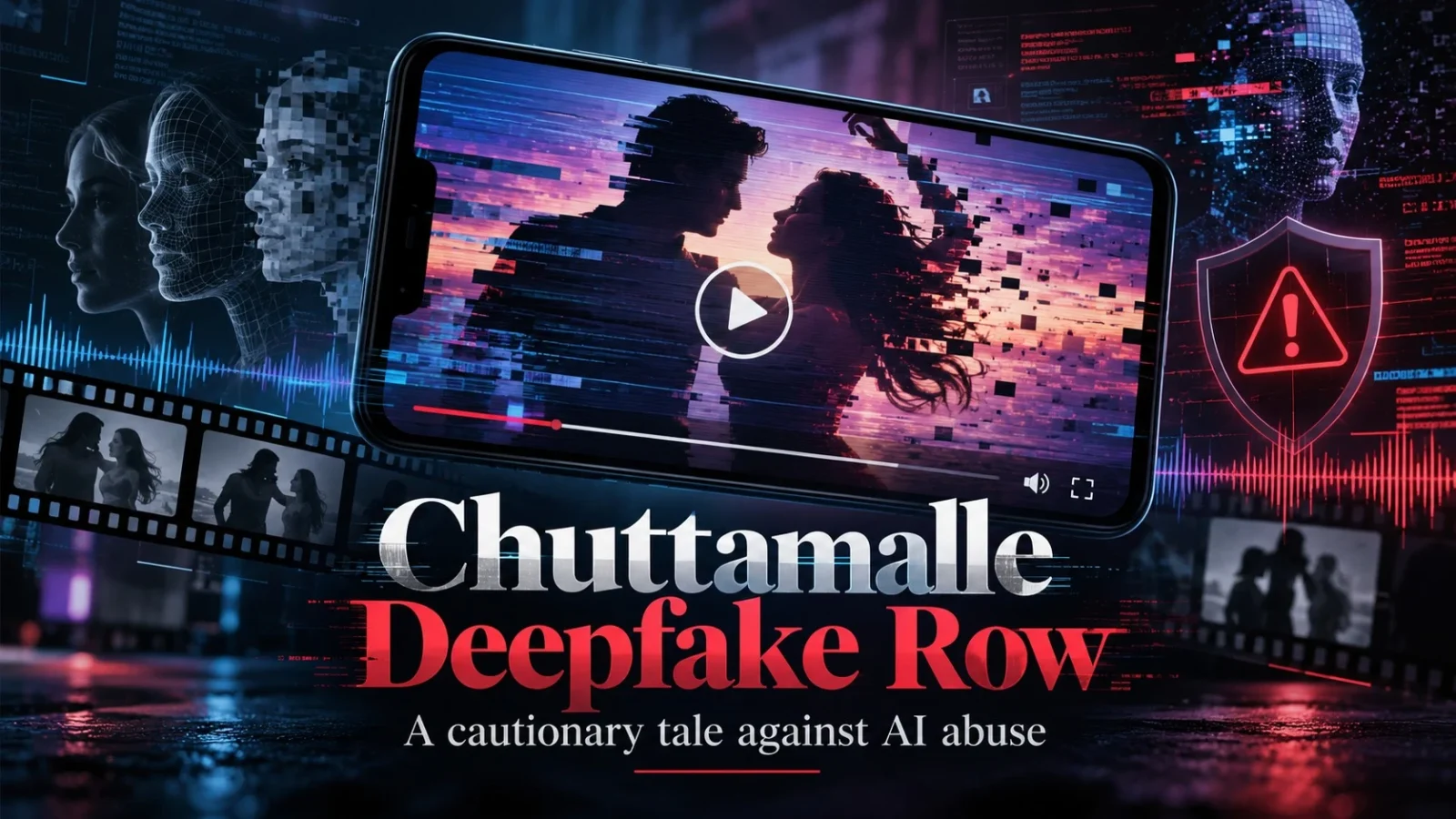
After the manipulated video of the popular song from Devara: Part 1 went viral online, Jr NTR, Janhvi Kapoor, Chiranjeevi, Vijay Deverakonda, Khushbu Sundar and other personalities from the film industry have reacted. The episode is turning into a broader fight over consent, platform accountability and how India handles synthetic media that targets real people.
By TechSota | Oct. 4, 2026
A song that has become one of the most recognizable musical moments in Devara: Part 1 is now at the center of a very different conversation.
The romantic song “Chuttamalle” featuring Jr NTR and Janhvi Kapoor is back in the news after manipulated footage of the song began circulating on social media. News organizations including The Indian Express, NDTV, India Today and others reported that artificial intelligence was used to alter the original footage and falsely depict Kapoor in degrading and sexually explicit situations. The Indian Express Why another celebrity video going viral is not a big deal It matters because it shows how a legitimate piece of professionally produced media can become raw material for synthetic abuse.
The source video was public. The people in it were well-known. The performance was already very recognizable. None of these facts give us license to manufacture a different reality for the people in it.
One of the defining problems of generative AI is the distinction between access to a person’s image and consent to alter their identity.
From a hit song to fake news
It was released in 2024 as part of director Koratala Siva’s Devara: Part 1 The original Telugu track was composed by Anirudh Ravichander, sung by Shilpa Rao and penned by Ramajogayya Sastry with Bosco Martis choreographing. Later, T-Series Telugu brought out the official full video. Amazon.com Music
The controversy today is not about the original song and its makers but an unauthorized manipulation of that material.
Reports say that the footage of Kapoor and Jr NTR was edited to create the imagery that never existed in the film. Janhvi Kapoor stated that it was disturbing to see AI-generated fake videos being circulated and urged people not to create, send or promote them, adding that legal action would be taken. Moneycontrol That reply was quickly echoed by voices from across the Indian film industry.
Jr NTR: Likely action against creators, distributors
One of the strongest responses was Jr NTR.
The material, which he described as “Disgusting. Sick. Shameless,” was being manipulated and he was looking to take legal action against those responsible for creating it and against people spreading it. He also requested that users not watch, redistribute or engage with the material. Indian Express That last point is important technologically.
Digital abuse isn’t just up to whoever hits the generate button. Its reach is dependent on distribution.
Searches, quote posts, reposts, reaction clips, screenshots, downloads and recommendation algorithms can all help give harmful synthetic material a longer lifespan. Even condemnation can inadvertently increase discoverability as people repeat the offending media’s identification or re-sharing.
Jr NTR framed the issue as being more than one celebrity or one video, and called for stronger government action against malicious AI use. Industry level response needed: Chiranjeevi on Indian Express
He said the issue shouldn’t be seen as one actor or one movie, and that both creators of and intentional amplifiers of harmful manipulated media need to be held accountable. He also said that he would take up the issue with the Telugu Film Chamber, Producers’ Council and other industry-related organizations. The Indian Express India Today, it was reported that Chiranjeevi proposed a special mechanism to provide assistance to the victims of such abuse. India Today It is a suggestion worth a look.
There is now a kind of threat facing actors, musicians and creators that traditional publicity, copyright and reputation teams were not built to handle. A modern response may require people who can preserve evidence, issue platform notices, identify reposting networks, work with cybercrime authorities, verify legitimate media, and coordinate legal action quickly.
Likeness protection is becoming infrastructure for an industry based on faces, voices and performances.
Vijay Deverakonda gives a sharper name to the abuse
Vijay Deverakonda’s reply changed the dictionary of the debate.
What happened, he said, was the “digital equivalent of sexual assault,” and that even if the event depicted never physically happened, a synthetic version can cause tangible harm. The Indian Express The deepfake problem is all about that framing.
The “it is not real” defense misses the injury. A fake video can still be seen by millions of real people, linked to the real name of a real person, indexed by real search systems and stored on real accounts and devices.
Synthetic content can be fiction but its consequences are not.
Khushbu Sundar: ‘A person’s body is not raw material’
Khushbu Sundar also condemned the manipulation and said that the targeting of women with morphed content is abusive and there should be accountability.
In her response she offered a particularly lucid formulation: “A woman’s body is not content.” NDTV
That statement captures a problem that goes far beyond movie stars.
Generative systems have lowered the technical barrier to altering faces, bodies and voices. Tasks that once required specialist visual-effects skills can now be tackled increasingly with consumer-facing tools, downloadable models or automated workflows.
That capability does not create an entitlement to use another person’s likeness.
Consent must continue to be part of the equation.
Yami Gautam also raises a similar concern about normal media editing
Yami Gautam has also raised a similar concern about the AI editing of celebrity images, urging media houses to use images in their original form and not alter someone is appearance without their knowledge and consent. Times of India
Her point takes the discussion from the obviously malicious deepfakes to the much wider gray area of routine AI editing.
When does retouching stop and identity manipulation begin?
Upscaling a low resolution press photo is a whole different ballgame to changing someone’s face, clothing, expression or body. But the tools to do those things are increasingly built into the same editing interfaces.
Newsrooms, entertainment outlets and social publishers will therefore need to have clearer internal rules about what kinds of AI-assisted modification are okay.
Ram Gopal Varma raises amplification issue
But film maker Ram Gopal Varma disagreed, and said the very fact that so many celebrities were responding to the doctored video could generate even more curiosity and visibility around it. The Indian Express reported his position as a criticism of the attention the public responses have garnered. The Indian Express The comment points to a tricky moderation dilemma.
Silence can allow abuse to go unchecked. More attention can be obtained by public denunciation.
There is no perfect answer, but there is a practical distinction: condemn the act, but not redistribute the material.
Responsible coverage does not have to embed the offending video, provide instructions on how to find it, publish screenshots from it or make it the visual centerpiece.
The story can be told without being just another distribution node.
Here, TechSota is going that route.
Why this is different than older photo manipulation, courtesy of AI
We’ve been working with images long before generative AI. What is different is the combination of realism, accessibility, speed and volume.
Modern generative systems can hallucinate missing pixels, alter clothing and environments, synthesize faces, reproduce voices, transfer facial motion and generate new sequences altogether. Advances in video generation also make temporal consistency — the ability to maintain a convincing subject across consecutive frames — all the more achievable.
That changes the economics of lying.
A convincing fake used to take time and skillful editing. The constraint is increasingly intent, not technical ability.
Bad actors don’t need perfect outcomes.
A fake only has to be credible long enough to be read on a small phone screen, compressed by social media and viewed for a few seconds while scrolling.
That makes detection an arms race, not a silver bullet.
India already has laws that can be used against deepfake abuse
The Chuttamalle case has revived calls for stricter regulation, but India is not starting with a clean legal slate.
The Ministry of Electronics and Information Technology said in a statement in August 2026 that the provisions of the Information Technology Act can be applied to conduct including identity theft, impersonation, privacy violations and the publication or transmission of obscene or sexually explicit material. The government also pointed to relevant provisions of the Bharatiya Nyaya Sanhita, concerning personation, false electronic records and some types of harmful misinformation. Press Information Bureau The framework became more specific this year.
Amendments to the IT Rules that took effect in February 2026 strengthened obligations around synthetically generated information, including requirements for labeling and traceable metadata for permissible synthetic content and quicker action on unlawful material, the government said. Press Information Bureau The rules specifically target areas such as impersonation and non-consensual intimate imagery, and also impose technical and due diligence responsibilities on online intermediaries. The Press Information Bureau India has also established a procedure for non-consensual intimate imagery and reporting through the National Cyber Crime Reporting Portal. Press Information Bureau For high-profile cases like this, the question will be less whether the rules exist, and more about how quickly the enforcement, detection and takedown works in practice.
Platforms start to automatically detect synthetic media
Platforms are moving from voluntary disclosure of AI to automated detection.
In May 2026, YouTube said it would begin using internal signals to detect when a lot of photorealistic AI has been used and automatically add AI labels in some cases where creators have not disclosed the manipulation themselves. It also said content with C2PA metadata marking it as fully generative can retain a permanent disclosure label. blog.google X’s policy prohibits sharing of non-consensual intimate media and specifically includes manipulated imagery that places a person’s face onto another nude body. X Help Center Detection and enforcement are better than policies.
A malicious upload can be mirrored, cropped, recompressed, screen recorded, renamed or moved across platforms. Each transformation makes it harder to match up.
That’s why the future of synthetic-media safety can’t hinge on one detector.
Provenance may be as important as detection
The second method poses a different question.
Instead of just trying to spot a fake image after it has been shared, can reputable media provide verifiable information about its origin and editing?
The Coalition for Content Provenance and Authenticity, or C2PA, is working on an open standard around this concept. Content Credentials can capture facts about origin and modification with digital resources in a cryptographically signed provenance record. In July 2026 C2PA released new implementation guidance on AI-generated, AI-modified and non-synthetic content. C2PA This is not a perfect deepfake detector.
Media without credentials cannot be automatically assumed fake, and metadata can be stripped. But provenance gives publishers and platforms something ordinary visual inspection cannot: a chain of authenticated information about content that is part of the system.
Authenticated originals could ultimately become an important defense for film studios, newsrooms and celebrity management teams.
Design question for AI companies also
The burden cannot be solely on victims and social networks.
And AI developers increasingly have a choice about what safeguards go inside generation systems themselves.
Possible defenses include likeness protections, classifiers for non-consensual sexual content, restrictions on certain transformation requests, invisible watermarking, output provenance, abuse monitoring, repeat-offender controls and mechanisms allowing public figures — and eventually ordinary people — to register or defend their likeness.
Neither one alone will do.
Responsible architecture requires multiple layers because any single barrier can be bypassed by open source tools, model modification, and cross-platform distribution.
Maybe the most important design principle is even more simple: consent cannot be an after-generation inconvenience.
For high-risk transformations involving identifiable real people, it should be a part of the product architecture.