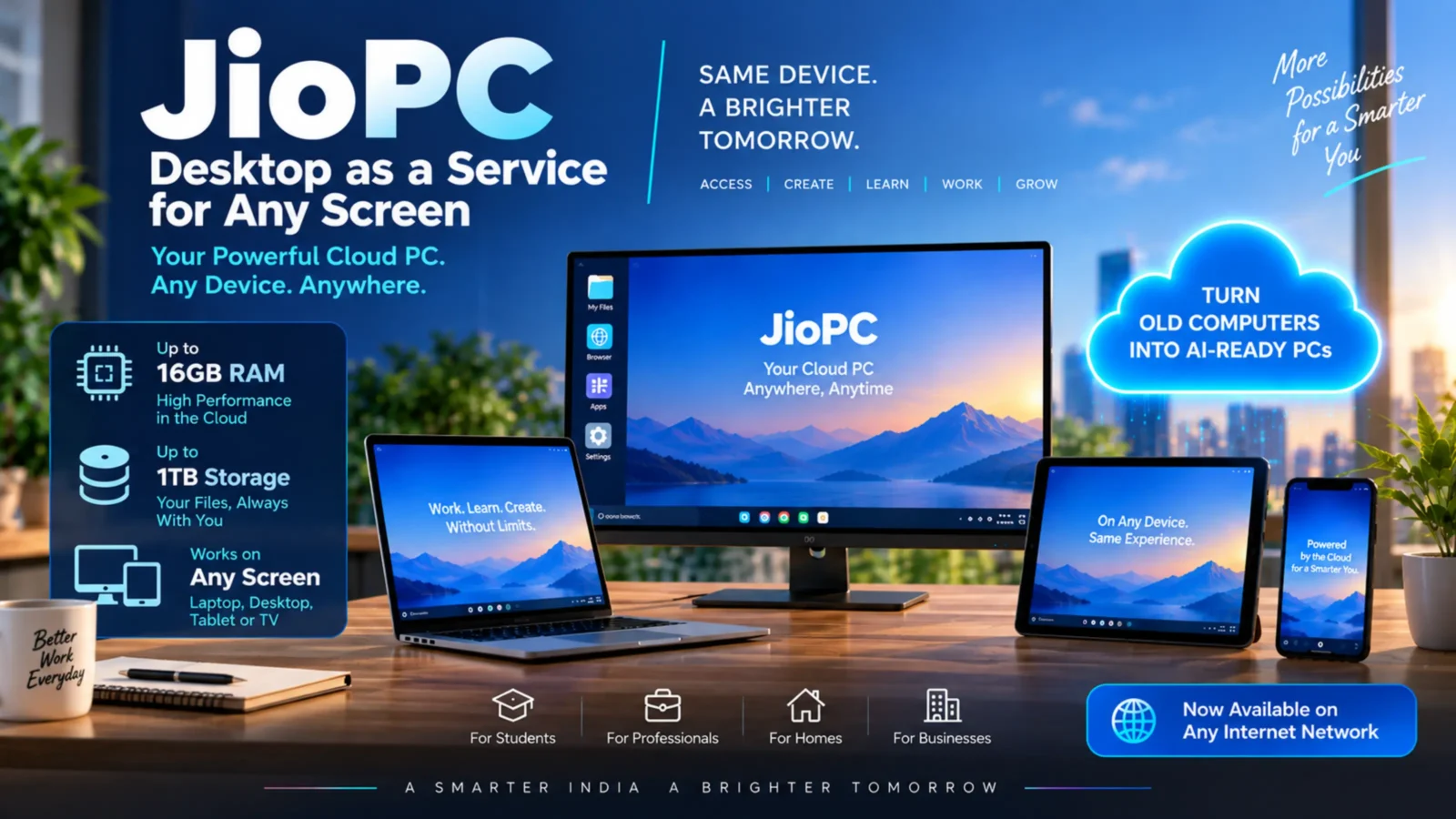
Jio has made the JioPC much more interesting than it was upon release. The cloud computing service is no longer exclusively tied to Jio Fiber or Jio Air Fiber for desktop and laptop owners. Anyone with a compatible browser and access to the internet-even if it comes from a competitor-can purchase it. Through a Jio set-top box this service can also render on a tv or monitor and however, it still requires a Jio broadband connection.
September 2026 iteration opens it up as an entirely standalone computational service. The target market: people who already possess slow but functioning machines and who are unwilling to replace them.
JioPC allows them to essentially rent compute instead.
What 1,000 will buy you.
There are two types of JioPC: Standard and Ultra. Standard version has 4 virtualized CPUs, 8GBs of RAM and 500GB of storage and the Ultra version doubles these specs and adds 16GB of RAM. Instead of Windows, both run Ubuntu.
According to Jio, the environment has access to LibreOffice and cloud versions of Microsoft 365, Adobe Express, among others. Files are stored on the company’s infrastructure, rather than locally.
Pricing is almost unthinkable given the service. The base price for the standard tier is 1,000 for two months, 2,000 for five months and 4,000 for ten months plus an extra two months thrown in for free. The Ultra tier costs 1,200 for two months, 2,500 for five months and 5,000 for ten months plus two free months. Prices quoted include GST.
The 11 rupees/day cost needs some context.
The headline of approximately 11 rupees a day is true-but only for the annual plan. If you spend 4,000 on the 10-month + two months free plan (effectively, 12 months) and divide by 365 days, it works out to about 10.96 rupees. For the Ultra plan on a 10-month + two months free subscription equivalent, the cost breaks down to 13.70 rupees.
The cheapest offering-1,000 for two months-comes out to about 16.67 rupees per day.
Still, even so, it presents a rather attractive offer for students, households, or small businesses that may already own a screen, keyboard, and computer. According to Jio, setting up takes under five minutes as it requires neither hardware upgrades nor data migration. The computing happens elsewhere, and a basic machine can essentially function as a gateway to the remote desktop.
“AI Ready” Does not Mean an AI PC.
The most bold claim Jio makes is that even older, eight-year-old computers can run AI apps by leveraging cloud power. In terms of a cloud computing service, that’s likely true. Buyers should be under no illusion that they are in fact buying an AI PC.
Microsoft has laid out the requirements for Copilot+PCs as being comprised of a dedicated, local neural processing unit (capable of at least 40 TOPS) and specified local hardware. Jio has said nothing about a dedicated, local AI processing unit, primarily because its solution operates in a completely different fashion. Its machines are not actually capable of hosting demanding AI applications themselves in a local environment because they lack high-speed hardware, local storage and a powerful CPU.
Can the JioPC take on a low-cost laptop?
Yes-in some cases. For users that primarily want web browsing, online coursework, office documents or coding (primarily for the web), the model is clearly suitable. It’s a particularly compelling prospect for people who would otherwise have to buy a three to eight-year-old machine purely out of hardware-driven slowness.
This does not do away with the fundamental strengths of having a laptop, however. Users must still possess some functioning device, a solid internet connection and manageable latency-and offline use is impossible. Additionally, native application compatibility doesn’t extend to browsers, and hardware issues like a damaged screen, battery or weak wifi must still be fixed.
Bigger vision seems to be taking away the necessity for buying new a budget laptop every few years, not making them irrelevant altogether.